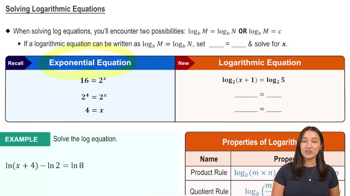
Recognize that the equation is given in logarithmic form: \(\log_{2} x = 3\). This means the logarithm base 2 of \(x\) equals 3.
Recall the definition of a logarithm: \(\log_{a} b = c\) means \(a^{c} = b\). Applying this to the equation, rewrite it as \$2^{3} = x$.
Calculate the exponent on the right side: \$2^{3}$ means 2 multiplied by itself 3 times.
Express the solution for \(x\) as \(x = 2^{3}\) without simplifying the numerical value, since the problem asks for the steps, not the final number.
Verify the solution by substituting \(x\) back into the original logarithmic equation to ensure it satisfies \(\log_{2} x = 3\).
Verified video answer for a similar problem:
This video solution was recommended by our tutors as helpful for the problem above
Video duration:
2m
Play a video:
0 Comments
Key Concepts
Here are the essential concepts you must grasp in order to answer the question correctly.
Definition of Logarithms
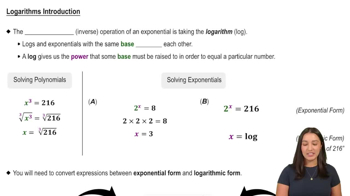
A logarithm answers the question: to what exponent must the base be raised to produce a given number? For example, log₂ x = 3 means 2 raised to the power 3 equals x. Understanding this definition is essential to rewrite and solve logarithmic equations.
Converting Logarithmic Equations to Exponential Form
Logarithmic equations can be solved by converting them into exponential form. For log₂ x = 3, rewrite it as x = 2³. This conversion simplifies solving for the unknown variable by using basic exponentiation.
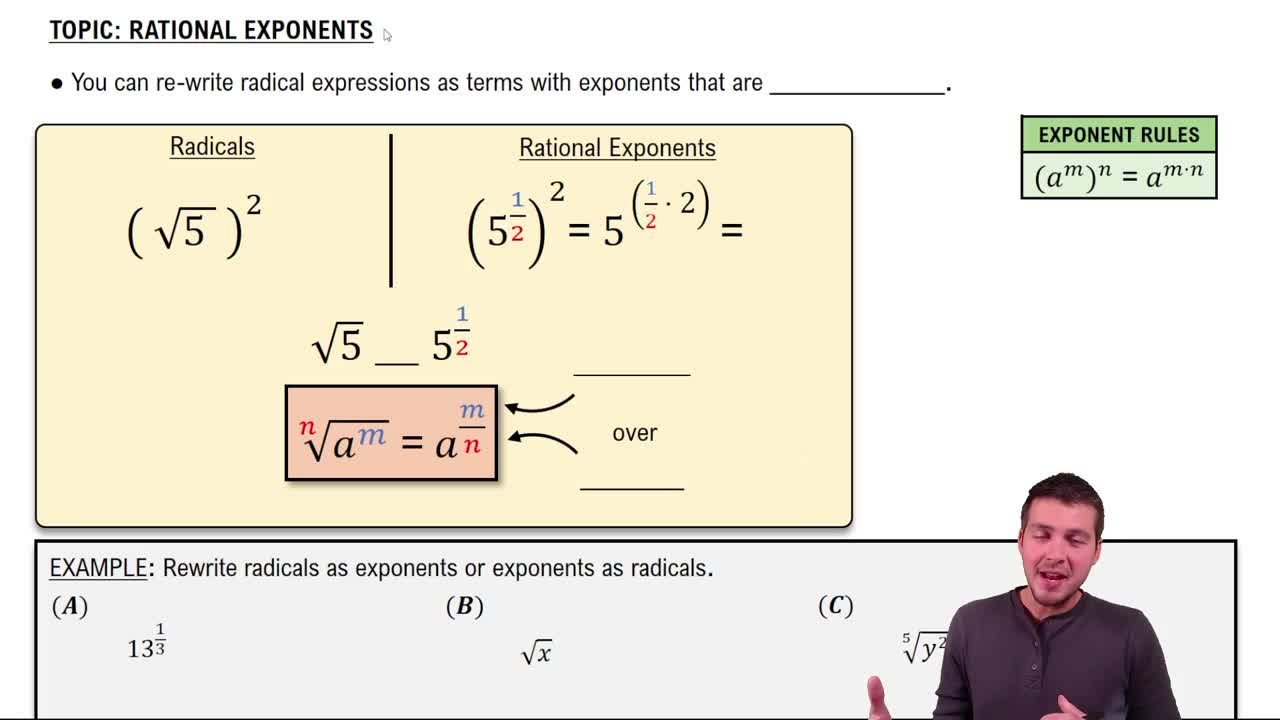
Once the logarithmic equation is converted, applying properties of exponents helps find the solution. Knowing that 2³ = 8 allows you to determine that x = 8. Mastery of exponent rules is crucial for solving and verifying logarithmic equations.

 2:22 minutes
 Verified step by step guidance
 7:30
7:30