Write an equation for each line described. Give answers in standard form for Exercises 11–20 and in slope-intercept form (if possible) for Exercises 21–32. through (-1,3), and (3,4)
Ch. 2 - Graphs and Functions

Chapter 3, Problem 19
For each piecewise-defined function, find (a) ƒ(-5), (b) ƒ(-1), (c) ƒ(0), and (d) ƒ(3).
Verified step by step guidance1
First, understand the piecewise function definition:
\[f(x) = \begin{cases} 2 + x & \text{if } x < -4 \\ -x & \text{if } -4 \leq x \leq 2 \\ 3x & \text{if } x > 2 \end{cases}\]
This means the function has three different expressions depending on the value of \(x\).
For each value of \(x\) given (\(-5\), \(-1\), \(0\), and \(3\)), determine which part of the piecewise function applies by checking the condition for \(x\) in the definition.
Evaluate \(f(-5)\): Since \(-5 < -4\), use the first expression \(f(x) = 2 + x\). Substitute \(x = -5\) into this expression.
Evaluate \(f(-1)\) and \(f(0)\): Both \(-1\) and \(0\) satisfy \(-4 \leq x \leq 2\), so use the second expression \(f(x) = -x\). Substitute \(x = -1\) and \(x = 0\) respectively.
Evaluate \(f(3)\): Since \$3 > 2\(, use the third expression \)f(x) = 3x\(. Substitute \)x = 3$ into this expression.

Verified video answer for a similar problem:
This video solution was recommended by our tutors as helpful for the problem above.
Video duration:
4mWas this helpful?
Key Concepts
Here are the essential concepts you must grasp in order to answer the question correctly.
Piecewise-Defined Functions
A piecewise-defined function is defined by different expressions depending on the input value's interval. Understanding how to identify which part of the function applies to a given x-value is essential for evaluating the function correctly.
Recommended video:
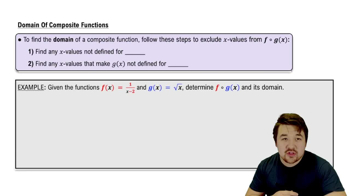
Domain Restrictions of Composed Functions
Evaluating Functions at Specific Points
Evaluating a function at a specific point means substituting the given x-value into the correct expression of the function and simplifying. This process requires careful attention to the domain restrictions of each piece.
Recommended video:
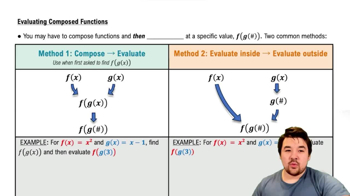
Evaluating Composed Functions
Inequalities and Interval Notation
Inequalities define the intervals for each piece of the function. Knowing how to interpret and apply inequalities like x < -4, -4 ≤ x ≤ 2, and x > 2 helps determine which formula to use for each input.
Recommended video:
Interval Notation
Related Practice
Textbook Question
770
views
Textbook Question
For the pair of functions defined, find (ƒg)(x).Give the domain of each. See Example 2.
ƒ(x)=3x+4, g(x)=2x-7
892
views
Textbook Question
For each graph, determine whether y is a function of x. Give the domain and range of each relation.
864
views
Textbook Question
For the pair of functions defined, find (ƒ-g)(x).Give the domain of each. See Example 2.
ƒ(x)=3x+4, g(x)=2x-6
1001
views
Textbook Question
In the following exercises, (a) find the center-radius form of the equation of each circle described, and (b) graph it. center (5, -4), radius 7
789
views
Textbook Question
For the pair of functions defined, find (ƒ+g)(x).Give the domain of each. See Example 2.
ƒ(x)=3x+4, g(x)=2x-5
904
views