Ch. 2 - Graphs and Functions
Lial - College Algebra 13th Edition
Lial13th EditionCollege AlgebraISBN: 9780136881063Not the one you use?Change textbook
Chapter 3, Problem 19

For each piecewise-defined function, find (a) ƒ(-5), (b) ƒ(-1), (c) ƒ(0), and (d) ƒ(3).
f(x)={2+xif x<4xif 4x23xif x>2f(x) =\(\begin{cases}\)2 + x & \(\text{if }\) x < -4 \\-x & \(\text{if }\) -4 \(\leq\) x \(\leq\) 2 \\3x & \(\text{if }\) x > 2\(\end{cases}\)

Verified step by step guidance
1
First, understand the piecewise function definition: \[f(x) = \begin{cases} 2 + x & \text{if } x < -4 \\ -x & \text{if } -4 \leq x \leq 2 \\ 3x & \text{if } x > 2 \end{cases}\] This means the function has three different expressions depending on the value of \(x\).
For each value of \(x\) given (\(-5\), \(-1\), \(0\), and \(3\)), determine which part of the piecewise function applies by checking the condition for \(x\) in the definition.
Evaluate \(f(-5)\): Since \(-5 < -4\), use the first expression \(f(x) = 2 + x\). Substitute \(x = -5\) into this expression.
Evaluate \(f(-1)\) and \(f(0)\): Both \(-1\) and \(0\) satisfy \(-4 \leq x \leq 2\), so use the second expression \(f(x) = -x\). Substitute \(x = -1\) and \(x = 0\) respectively.
Evaluate \(f(3)\): Since \$3 > 2\(, use the third expression \)f(x) = 3x\(. Substitute \)x = 3$ into this expression.

Verified video answer for a similar problem:

This video solution was recommended by our tutors as helpful for the problem above.
Video duration:
4m
Was this helpful?

Key Concepts

Here are the essential concepts you must grasp in order to answer the question correctly.

Piecewise-Defined Functions

A piecewise-defined function is defined by different expressions depending on the input value's interval. Understanding how to identify which part of the function applies to a given x-value is essential for evaluating the function correctly.
Recommended video:
3:51
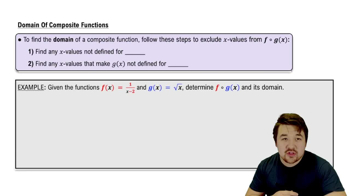
Domain Restrictions of Composed Functions

Evaluating Functions at Specific Points

Evaluating a function at a specific point means substituting the given x-value into the correct expression of the function and simplifying. This process requires careful attention to the domain restrictions of each piece.
Recommended video:
4:26
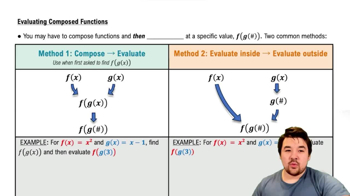
Evaluating Composed Functions

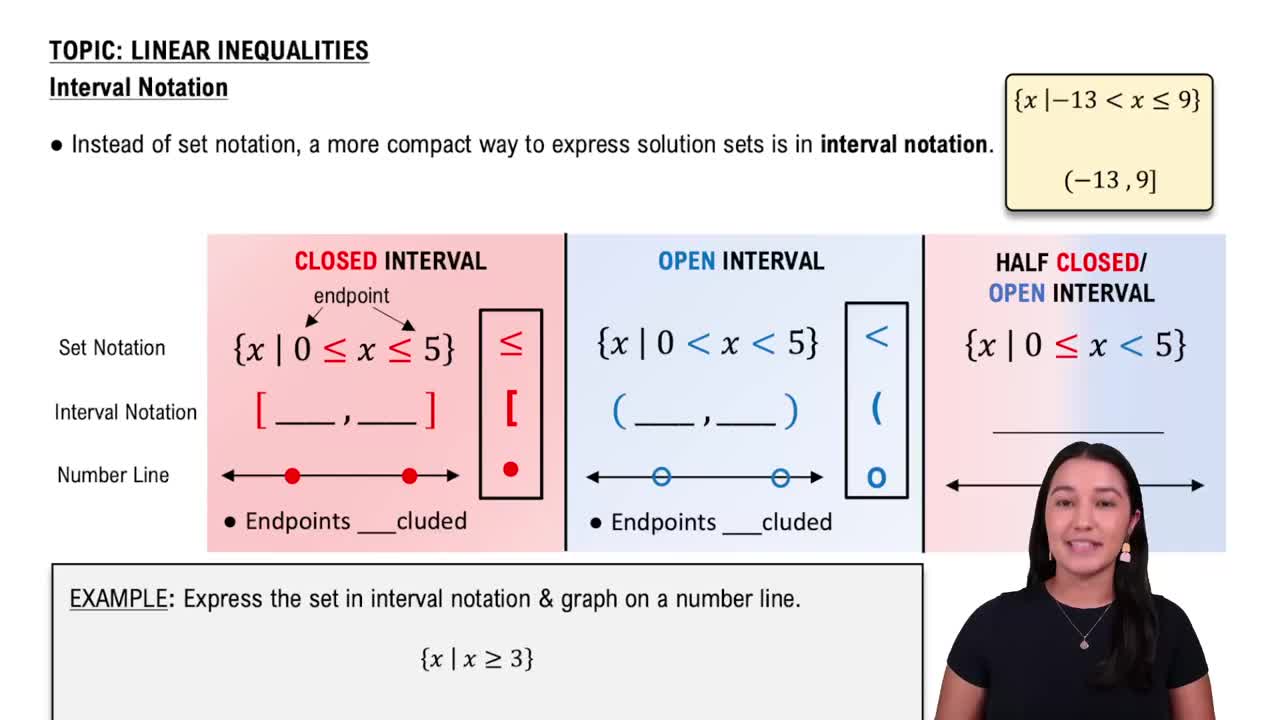
Inequalities and Interval Notation

Inequalities define the intervals for each piece of the function. Knowing how to interpret and apply inequalities like x < -4, -4 ≤ x ≤ 2, and x > 2 helps determine which formula to use for each input.
Recommended video:
05:18
Interval Notation