Identify the equation given: \$3^{x^2} = 45\(. Our goal is to solve for \)x$.
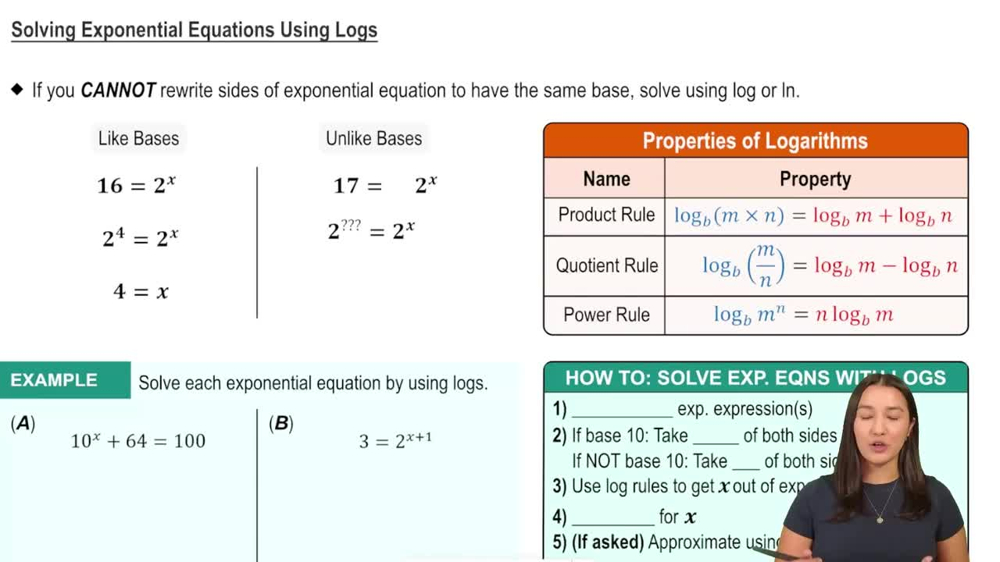
Take the natural logarithm (or log base 10) of both sides to help bring down the exponent. This gives: \(\ln(3^{x^2}) = \ln(45)\).
Use the logarithmic property that allows you to move the exponent in front: \(x^2 \cdot \ln(3) = \ln(45)\).
Isolate \(x^2\) by dividing both sides by \(\ln(3)\): \(x^2 = \frac{\ln(45)}{\ln(3)}\).
Finally, solve for \(x\) by taking the square root of both sides: \(x = \pm \sqrt{\frac{\ln(45)}{\ln(3)}}\). Remember to consider both the positive and negative roots.
Verified video answer for a similar problem:
This video solution was recommended by our tutors as helpful for the problem above
Video duration:
2m
Play a video:
0 Comments
Key Concepts
Here are the essential concepts you must grasp in order to answer the question correctly.
Exponential Equations
Exponential equations involve variables in the exponent, such as 3^(x^2) = 45. Solving these requires understanding how to manipulate and isolate the exponential expression to find the variable's value.
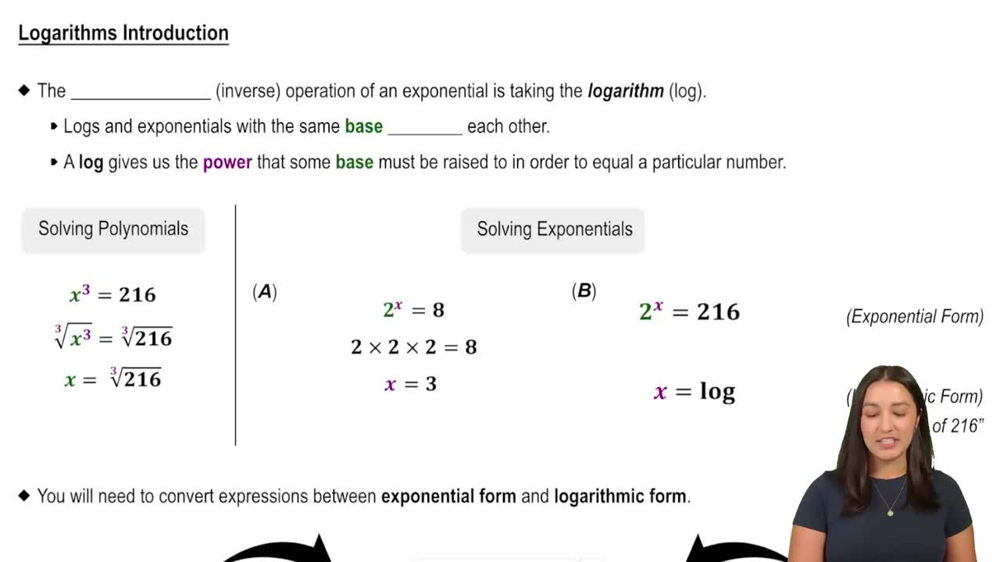
Logarithms are the inverse operations of exponentials and are used to solve equations where the variable is an exponent. Applying logarithms allows you to rewrite the equation in a form that makes the exponent accessible for solving.
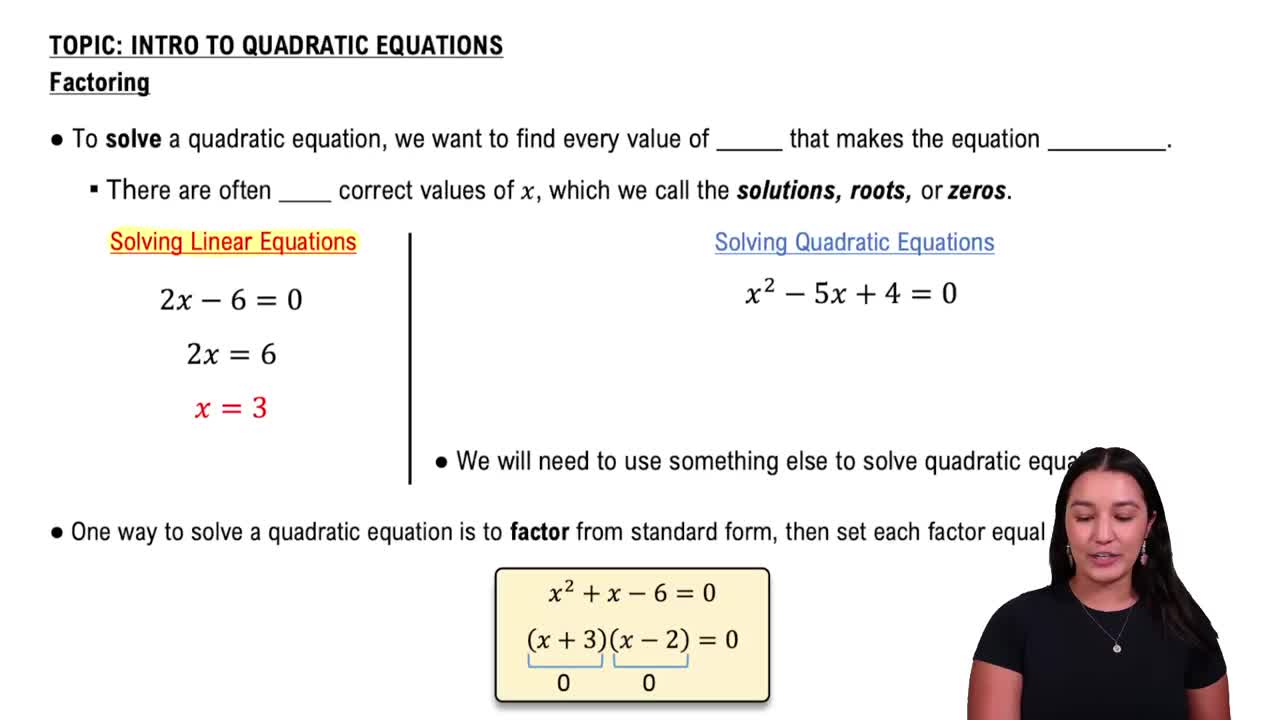
When the exponent is a quadratic expression like x^2, after applying logarithms, you often get a quadratic equation. Solving this requires techniques such as factoring, completing the square, or using the quadratic formula to find the values of x.

 2:29 minutes
 Verified step by step guidance
 5:47
5:47