Solve each equation for the indicated variable. Use logarithms with the appropriate bases. log A = log B - C log x, for A
Verified step by step guidance
1
Start with the given equation: \(\log A = \log B - C \log x\).
Recall the logarithm property that allows combining terms: \(a \log b = \log b^a\). Use this to rewrite \(C \log x\) as \(\log x^C\), so the equation becomes \(\log A = \log B - \log x^C\).
Use the logarithm subtraction rule: \(\log m - \log n = \log \left( \frac{m}{n} \right)\), to combine the right side into a single logarithm: \(\log A = \log \left( \frac{B}{x^C} \right)\).
Since \(\log A = \log \left( \frac{B}{x^C} \right)\), the arguments must be equal (assuming the logs have the same base), so set \(A = \frac{B}{x^C}\).
Solve for \(x\) by isolating it: multiply both sides by \(x^C\) to get \(A x^C = B\), then divide both sides by \(A\) to get \(x^C = \frac{B}{A}\). Finally, take the \(C\)-th root of both sides to solve for \(x\): \(x = \left( \frac{B}{A} \right)^{\frac{1}{C}}\).
Verified video answer for a similar problem:
This video solution was recommended by our tutors as helpful for the problem above
Video duration:
4m
Play a video:
0 Comments
Key Concepts
Here are the essential concepts you must grasp in order to answer the question correctly.
Properties of Logarithms
Understanding the properties of logarithms, such as the product, quotient, and power rules, is essential. These properties allow you to combine or separate logarithmic expressions, making it easier to isolate variables and simplify equations.
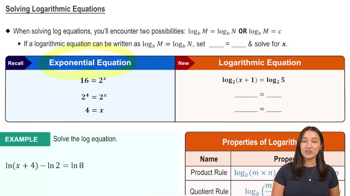
Solving logarithmic equations involves rewriting the equation to isolate the logarithmic term and then converting it to its exponential form. This process helps in solving for the variable inside the logarithm by removing the log function.
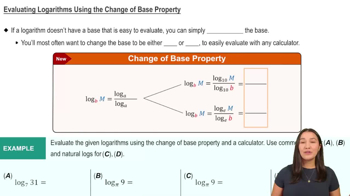
Recognizing the base of logarithms and using the change of base formula when necessary is important. This allows you to work with logarithms of different bases and apply appropriate logarithmic rules to solve for the variable.