Ch. 4 - Exponential and Logarithmic Functions
Blitzer - College Algebra 8th Edition
Blitzer8th EditionCollege AlgebraISBN: 9780136970514Not the one you use?Change textbook
Chapter 5, Problem 94

Solve each equation. 3x+2 ⋅ 3x=81

Verified step by step guidance
1
Recognize that the equation involves exponential expressions with the same base, which is 3: \(3^{x+2} \cdot 3^{x} = 81\).
Use the property of exponents that states when multiplying like bases, you add the exponents: \(3^{x+2} \cdot 3^{x} = 3^{(x+2) + x} = 3^{2x+2}\).
Rewrite the right side of the equation, 81, as a power of 3. Since \(81 = 3^4\), the equation becomes \(3^{2x+2} = 3^4\).
Set the exponents equal to each other because the bases are the same: \(2x + 2 = 4\).
Solve the linear equation for \(x\): subtract 2 from both sides to get \(2x = 2\), then divide both sides by 2 to find \(x\).

Verified video answer for a similar problem:

This video solution was recommended by our tutors as helpful for the problem above.
Video duration:
2m
Was this helpful?

Key Concepts

Here are the essential concepts you must grasp in order to answer the question correctly.

Properties of Exponents

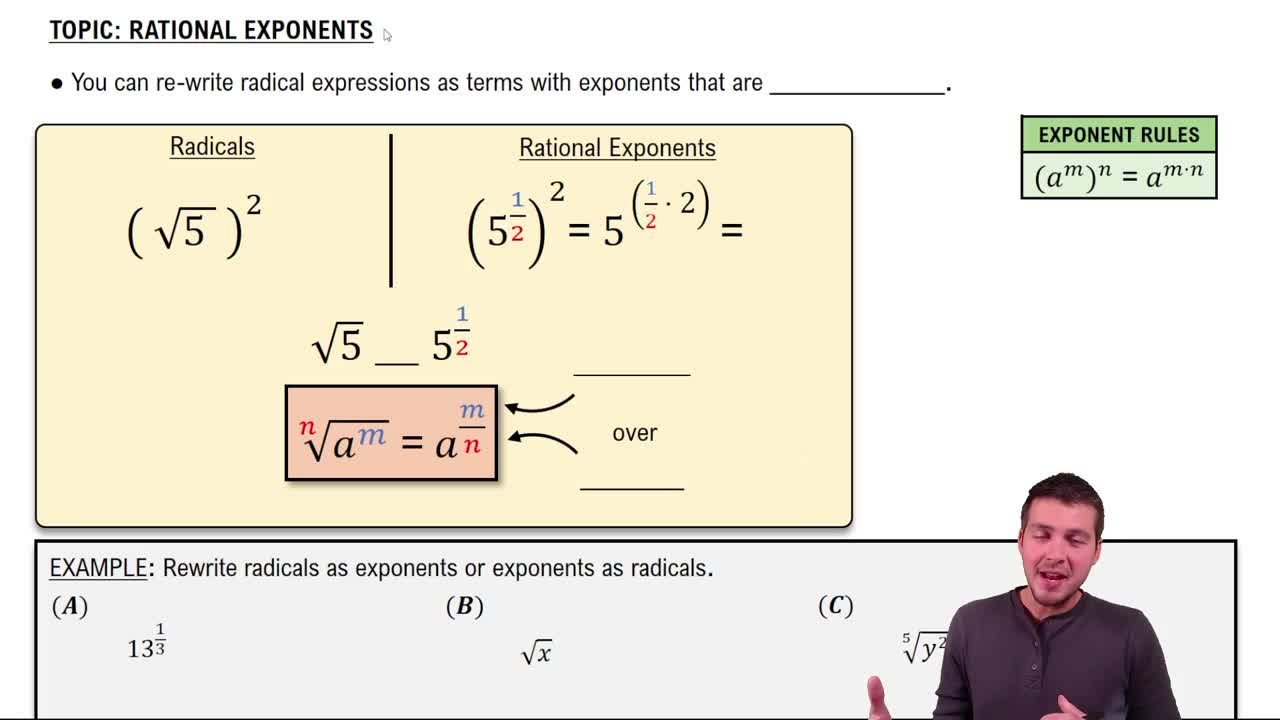
This concept involves rules for manipulating expressions with exponents, such as multiplying powers with the same base by adding their exponents. For example, 3^(x+2) * 3^x equals 3^[(x+2) + x] = 3^(2x+2). Understanding these properties simplifies solving exponential equations.
Recommended video:
Guided course
04:06
Rational Exponents

Expressing Numbers as Powers of the Same Base

To solve exponential equations, it helps to rewrite constants as powers of the same base as the variable terms. Here, 81 can be expressed as 3^4, allowing the equation to be set with equal bases and exponents, facilitating the solution.
Recommended video:
05:10
Higher Powers of i

Solving Linear Equations

After equating the exponents, the problem reduces to solving a linear equation in terms of x. This involves isolating x by performing algebraic operations such as addition, subtraction, multiplication, or division to find its value.
Recommended video:
04:02
Solving Linear Equations with Fractions