Ch. 3 - Polynomial and Rational Functions
Lial - College Algebra 13th Edition
Lial13th EditionCollege AlgebraISBN: 9780136881063Not the one you use?Change textbook
Chapter 4, Problem 8

Determine whether each statement is true or false. If false, explain why. The product of a complex number and its conjugate is always a real number.

Verified step by step guidance
1
Recall the definition of a complex number: it is of the form \(z = a + bi\), where \(a\) and \(b\) are real numbers and \(i\) is the imaginary unit with \(i^2 = -1\).
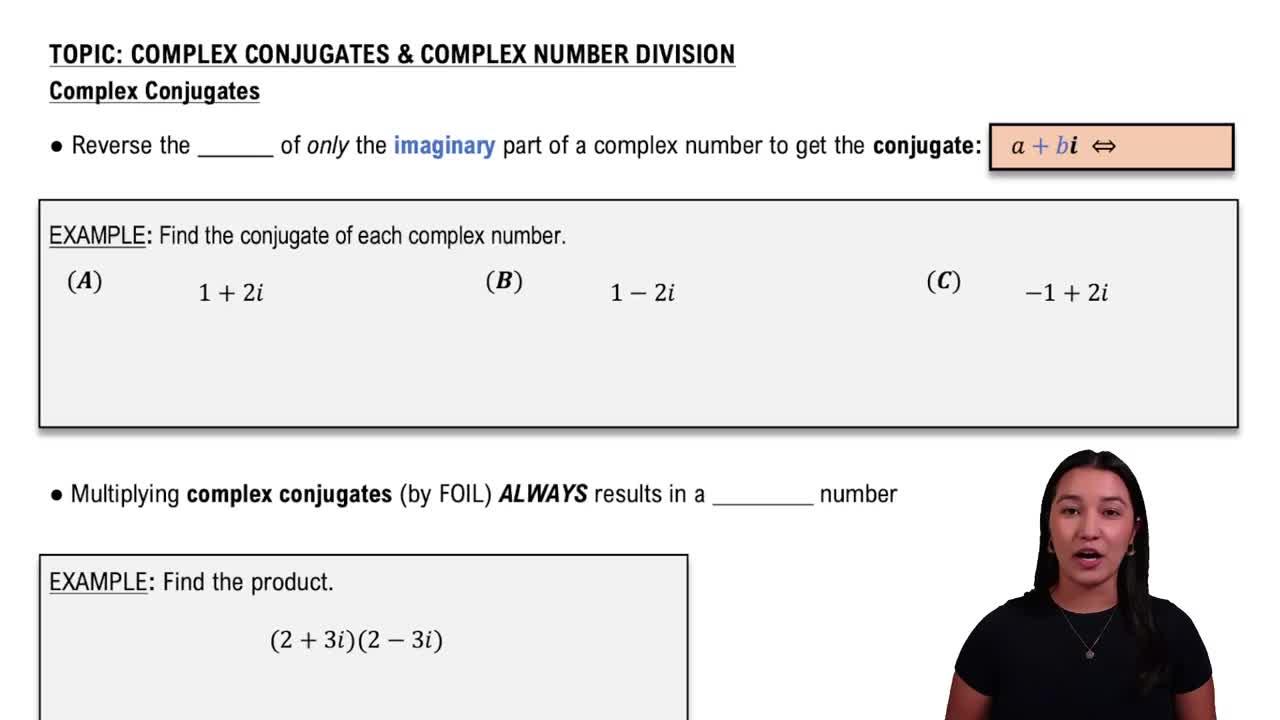
The conjugate of a complex number \(z = a + bi\) is given by \(\overline{z} = a - bi\).
To find the product of a complex number and its conjugate, multiply \(z\) and \(\overline{z}\): \(z \times \overline{z} = (a + bi)(a - bi)\).
Use the distributive property (FOIL) to expand the product: \((a + bi)(a - bi) = a^2 - abi + abi - b^2 i^2\).
Simplify the expression by combining like terms and using \(i^2 = -1\): the middle terms cancel out, and \(-b^2 i^2\) becomes \(+b^2\), so the product is \(a^2 + b^2\), which is a real number.

Verified video answer for a similar problem:

This video solution was recommended by our tutors as helpful for the problem above.
Video duration:
2m
Was this helpful?

Key Concepts

Here are the essential concepts you must grasp in order to answer the question correctly.

Complex Numbers

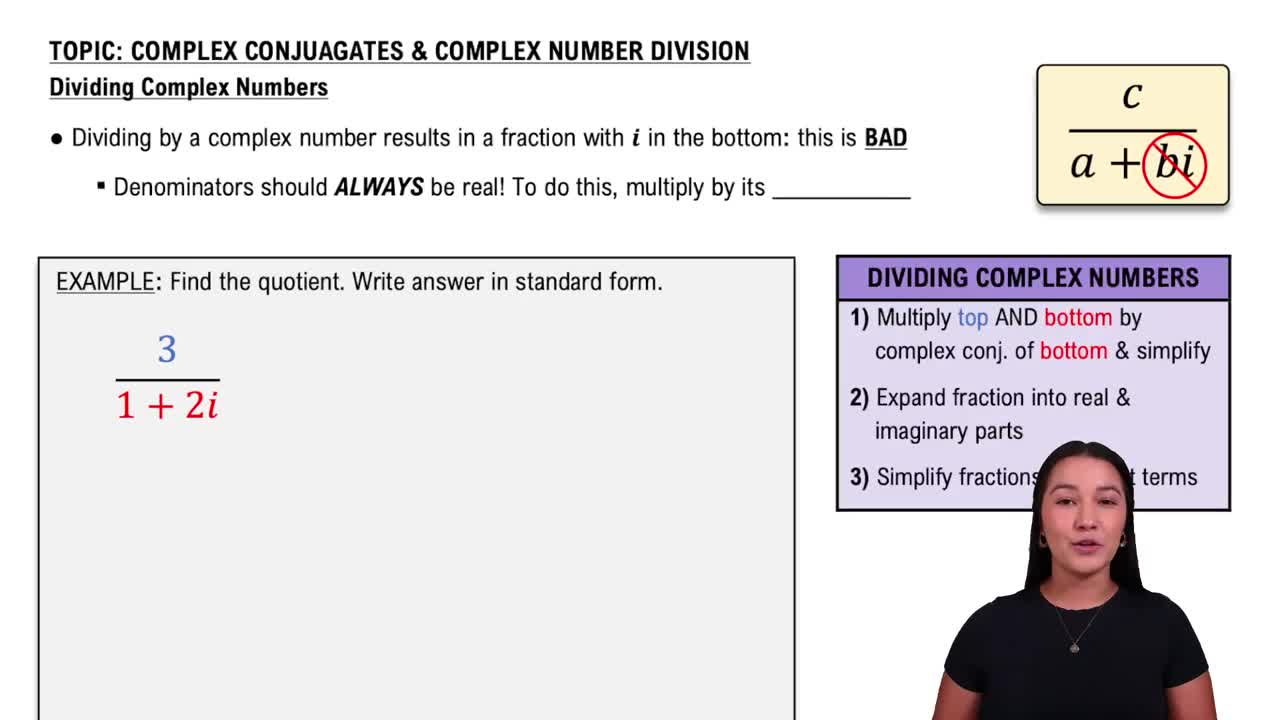
A complex number is a number in the form a + bi, where a and b are real numbers and i is the imaginary unit with the property i² = -1. Complex numbers extend the real number system and are used to represent quantities with both real and imaginary parts.
Recommended video:
04:22
Dividing Complex Numbers

Complex Conjugate

The complex conjugate of a complex number a + bi is a - bi. It reflects the number across the real axis in the complex plane, changing the sign of the imaginary part while keeping the real part the same.
Recommended video:
05:33
Complex Conjugates

Product of a Complex Number and Its Conjugate

Multiplying a complex number by its conjugate results in a real number equal to a² + b², which is the sum of the squares of the real and imaginary parts. This product is always non-negative and has no imaginary component.
Recommended video:
05:33
Complex Conjugates
Related Practice
Textbook Question

Use the graph to solve each equation or inequality. Use interval notation where appropriate. 2(x-2) / {(x-1)(x-3)} < 0

502
views
Textbook Question

Solve each problem. During the course of a year, the number of volunteers available to run a food bank each month is modeled by V(x)V(x), where V(x)=2x232x+150V(x)=2x^2-32x+150 between the months of January and August. Here x is time in months, with x=1 representing January. From August to December, V(x)V(x) is modeled by V(x)=31x226V(x)=31x-226. Find the number of volunteers in each of the following months. Sketch a graph of y=V(x)y=V(x) for January through December. In what month are the fewest volunteers available?

724
views
Textbook Question

Solve each problem. If m varies jointly as x and y, and m=10 when x=2 and y=14, find m when x=21 and y=8.

578
views
Textbook Question

Provide a short answer to each question. Is ƒ(x)=1/x an even or an odd function? What symmetry does its graph exhibit?

613
views
Textbook Question

Graph each function. Determine the largest open intervals of the domain over which each function is (a) increasing or (b) decreasing. ƒ(x)=2x4

935
views
Textbook Question

Solve each problem. During the course of a year, the number of volunteers available to run a food bank each month is modeled by V(x)V(x), where V(x)=2x232x+150V(x)=2x^2-32x+150 between the months of January and August. Here x is time in months, with x=1 representing January. From August to December, V(x)V(x) is modeled by V(x)=31x226V(x)=31x-226. Find the number of volunteers in each of the following months.

December

517
views