Ch. 3 - Polynomial and Rational Functions
Lial - College Algebra 13th Edition
Lial13th EditionCollege AlgebraISBN: 9780136881063Not the one you use?Change textbook
Chapter 4, Problem 6

Use the graph to solve each equation or inequality. Use interval notation where appropriate. 7x(x - 1)(x - 2) ≥ 0

Verified step by step guidance
1
Identify the roots of the function from the equation \$7x(x - 1)(x - 2) = 0\(. These roots are the values of \)x\( where the function equals zero, which are \)x = 0\(, \)x = 1\(, and \)x = 2$.
Use the roots to divide the number line into intervals: \((-\infty, 0)\), \((0, 1)\), \((1, 2)\), and \((2, \infty)\).
Determine the sign of the function \$7x(x - 1)(x - 2)$ on each interval by choosing a test point from each interval and substituting it into the function.
From the graph, observe where the function is greater than or equal to zero (i.e., where the graph is on or above the x-axis). This corresponds to the intervals where the function is positive or zero.
Combine the intervals where the function is non-negative and include the roots where the function equals zero to write the solution in interval notation.

Verified video answer for a similar problem:

This video solution was recommended by our tutors as helpful for the problem above.
Video duration:
6m
Was this helpful?

Key Concepts

Here are the essential concepts you must grasp in order to answer the question correctly.

Polynomial Inequalities

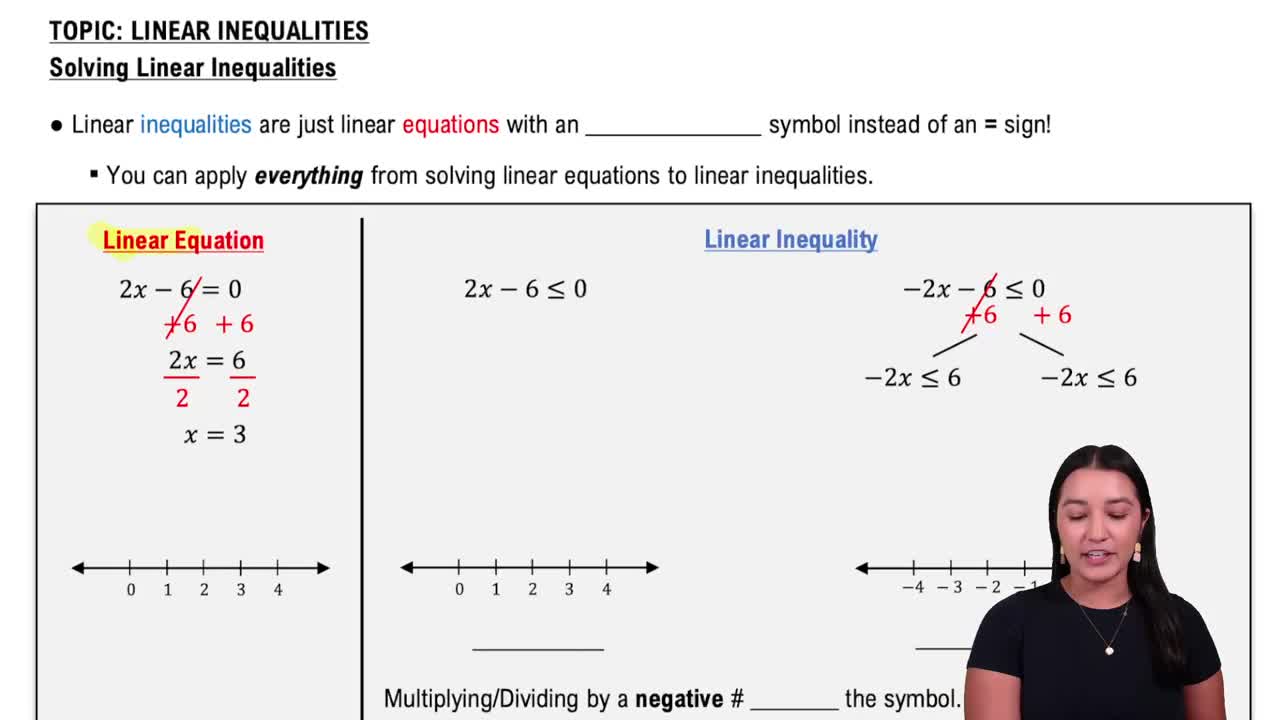
Polynomial inequalities involve expressions where a polynomial is compared to zero or another value using inequality signs (>, <, ≥, ≤). Solving these requires finding where the polynomial is positive, negative, or zero, often by analyzing its roots and the sign of intervals between them.
Recommended video:
06:07
Linear Inequalities

Roots and Zeros of a Polynomial

The roots or zeros of a polynomial are the values of x where the polynomial equals zero. These points divide the number line into intervals, which are tested to determine the sign of the polynomial in each interval, crucial for solving inequalities.
Recommended video:
02:20
Imaginary Roots with the Square Root Property

Using Graphs to Solve Inequalities

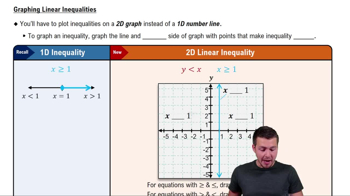
Graphs visually represent polynomial functions, showing where the function is above or below the x-axis. For inequalities like f(x) ≥ 0, the solution corresponds to x-values where the graph is on or above the x-axis, making it easier to identify solution intervals.
Recommended video:
Guided course
7:02
Linear Inequalities