Ch. R - Review of Basic Concepts
Lial - College Algebra 13th Edition
Lial13th EditionCollege AlgebraISBN: 9780136881063Not the one you use?Change textbook
Chapter 1, Problem 2

Determine whether each statement is true or false. If false, correct the right side of the equation. (y2)(y5) = y7

Verified step by step guidance
1
Recall the product rule for exponents: when multiplying expressions with the same base, you add the exponents. Mathematically, this is written as \(a^{m} \times a^{n} = a^{m+n}\).
Identify the base and exponents in the given expression: \((y^{2})(y^{5})\). Here, the base is \(y\), and the exponents are 2 and 5.
Apply the product rule by adding the exponents: \$2 + 5 = 7$.
Rewrite the expression using the sum of the exponents: \((y^{2})(y^{5}) = y^{7}\).
Conclude that the original statement is true because the right side correctly represents the product of the left side using the product rule for exponents.

Verified video answer for a similar problem:

This video solution was recommended by our tutors as helpful for the problem above.
Video duration:
1m
Was this helpful?

Key Concepts

Here are the essential concepts you must grasp in order to answer the question correctly.

Laws of Exponents

The laws of exponents govern how to simplify expressions involving powers of the same base. Specifically, when multiplying like bases, you add their exponents: a^m * a^n = a^(m+n). This rule is essential for correctly simplifying expressions like (y^2)(y^5).
Recommended video:
Guided course
04:06
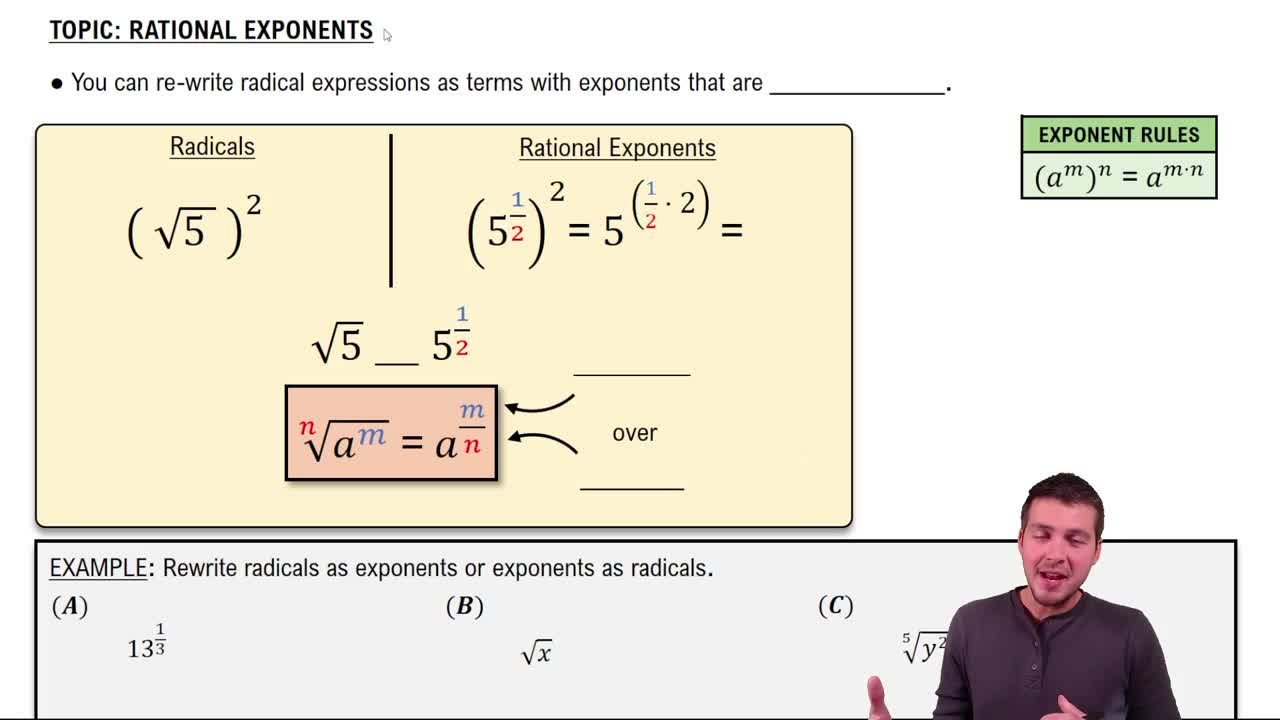
Rational Exponents

Base Consistency in Exponentiation

For exponent rules to apply directly, the bases must be identical. In the expression (y^2)(y^5), both terms have the base y, allowing the exponents to be combined. Recognizing the base ensures proper application of exponent laws.
Recommended video:
4:46
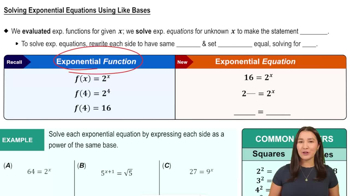
Solving Exponential Equations Using Like Bases

Evaluating True or False Statements in Algebra

Determining the truth of algebraic statements involves verifying if both sides of an equation are equivalent under given rules. If false, the correct form must be identified by applying relevant algebraic principles, such as exponent laws in this case.
Recommended video:
Guided course
03:11
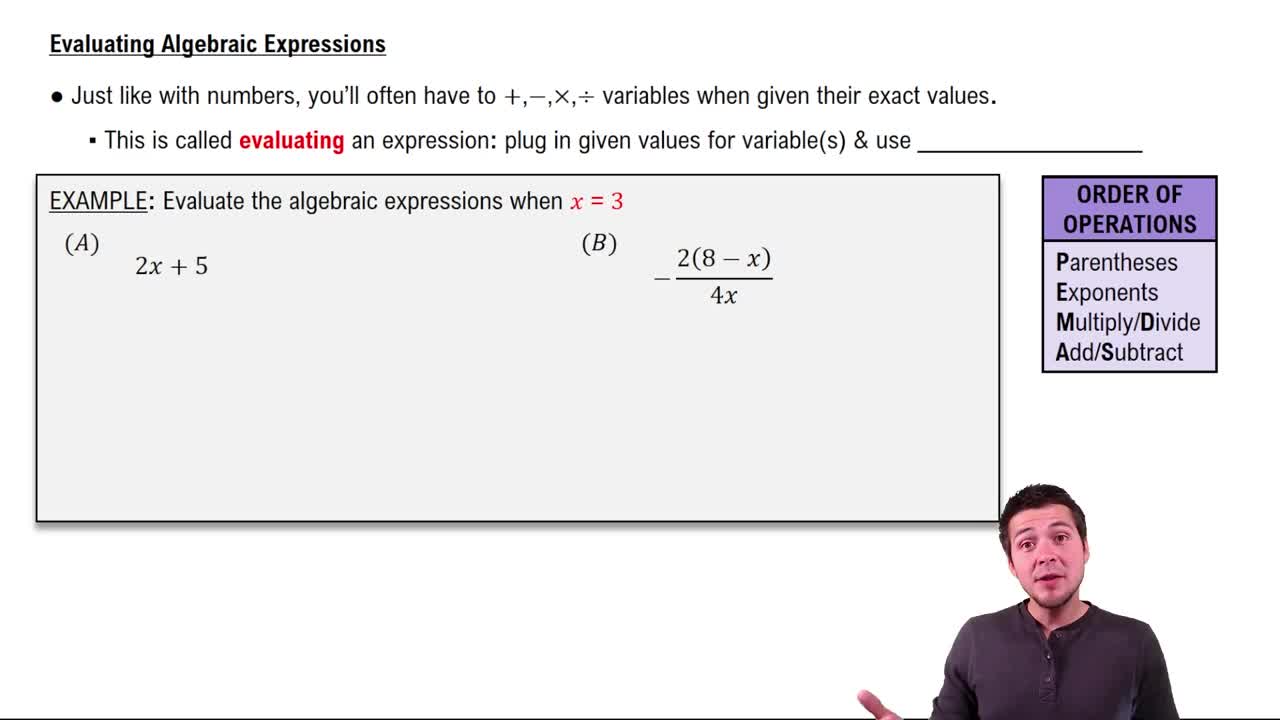
Evaluating Algebraic Expressions