Graph each quadratic function. Give the vertex, axis, x-intercepts, y-intercept, domain, range, and largest open intervals of the domain over which each function is increasing or decreasing. ƒ(x)=-3x2-12x-1
Verified step by step guidance
1
Identify the quadratic function given: \(f(x) = -3x^2 - 12x - 1\). Notice it is in the form \(ax^2 + bx + c\) where \(a = -3\), \(b = -12\), and \(c = -1\).
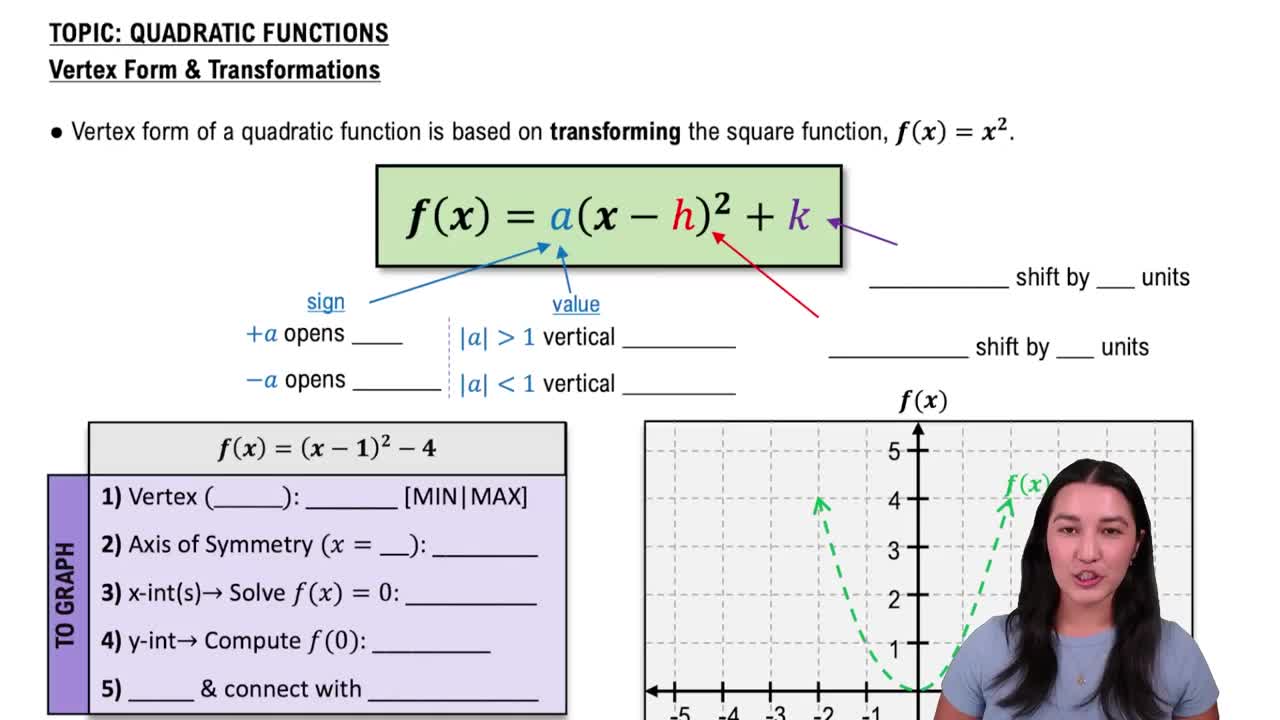
Find the vertex using the vertex formula. The x-coordinate of the vertex is given by \(x = -\frac{b}{2a}\). Substitute \(a\) and \(b\) to find \(x\), then plug this value back into \(f(x)\) to find the y-coordinate of the vertex.
Determine the axis of symmetry, which is the vertical line passing through the vertex. This line has the equation \(x = -\frac{b}{2a}\).
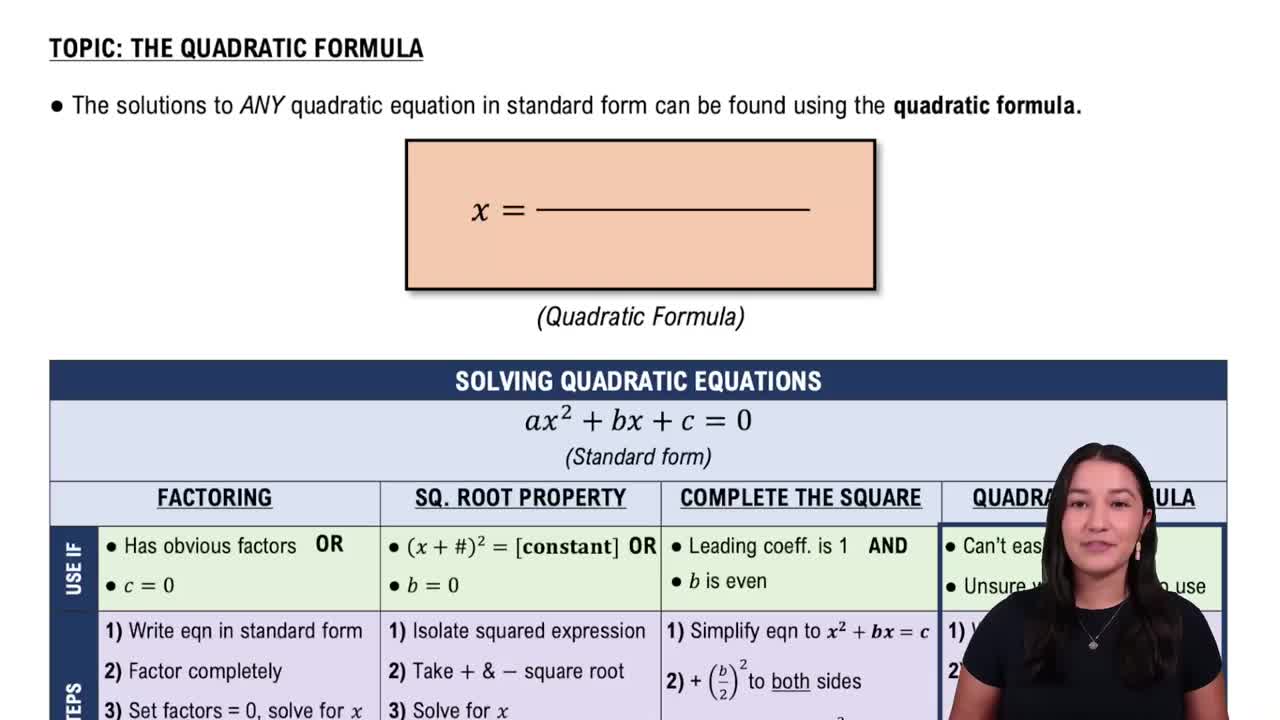
Find the x-intercepts by solving the quadratic equation \(-3x^2 - 12x - 1 = 0\). Use the quadratic formula \(x = \frac{-b \pm \sqrt{b^2 - 4ac}}{2a}\) to find the roots, which are the x-intercepts.
Find the y-intercept by evaluating \(f(0)\), which is simply the constant term \(c\) in the quadratic function.
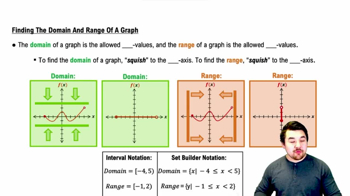
State the domain of the function, which for any quadratic function is all real numbers: \((-\infty, \infty)\).
Determine the range by analyzing the vertex and the direction the parabola opens. Since \(a = -3 < 0\), the parabola opens downward, so the vertex represents the maximum point. The range is all \(y\) values less than or equal to the vertex's y-coordinate.
Identify the intervals where the function is increasing and decreasing. For a downward-opening parabola, the function decreases to the left of the vertex and increases to the right of the vertex, or vice versa. Use the vertex's x-coordinate to split the domain into these intervals.
Verified video answer for a similar problem:
This video solution was recommended by our tutors as helpful for the problem above
Video duration:
12m
Play a video:
0 Comments
Key Concepts
Here are the essential concepts you must grasp in order to answer the question correctly.
Vertex of a Quadratic Function
The vertex is the highest or lowest point on the graph of a quadratic function, given by the formula (-b/2a, f(-b/2a)) for f(x) = ax^2 + bx + c. It represents the maximum or minimum value of the function and is crucial for graphing and understanding the parabola's shape.
The x-intercepts are points where the graph crosses the x-axis, found by solving f(x) = 0. The y-intercept is where the graph crosses the y-axis, found by evaluating f(0). These intercepts help locate the parabola on the coordinate plane and provide key points for sketching.
Solving Quadratic Equations Using The Quadratic Formula
Domain, Range, and Intervals of Increase/Decrease
The domain of any quadratic function is all real numbers. The range depends on the vertex and the parabola's direction (up or down). The function increases or decreases on intervals determined by the vertex's x-value; it decreases before the vertex and increases after if the parabola opens upward, and vice versa if it opens downward.