Ch. 1 - Equations and Inequalities
Lial - College Algebra 13th Edition
Lial13th EditionCollege AlgebraISBN: 9780136881063Not the one you use?Change textbook
Chapter 2, Problem 12

Solve each problem. See Example 1. Michael must build a rectangular storage shed. He wants the length to be 6 ft greater than the width, and the perimeter will be 44 ft. Find the length and the width of the shed.

Verified step by step guidance
1
Define variables for the dimensions of the shed: let the width be \(w\) feet, and since the length is 6 feet greater than the width, the length will be \(w + 6\) feet.
Write the formula for the perimeter of a rectangle, which is \(P = 2 \times (\text{length} + \text{width})\). Substitute the given perimeter and expressions for length and width: \(44 = 2 \times ((w + 6) + w)\).
Simplify the equation inside the parentheses: \(44 = 2 \times (2w + 6)\).
Distribute the 2 on the right side: \$44 = 4w + 12$.
Solve the linear equation for \(w\) by isolating the variable: subtract 12 from both sides to get \$44 - 12 = 4w\(, then divide both sides by 4 to find \)w\(. Once \)w\( is found, calculate the length by adding 6 to \)w$.

Verified video answer for a similar problem:

This video solution was recommended by our tutors as helpful for the problem above.
Video duration:
3m
Was this helpful?

Key Concepts

Here are the essential concepts you must grasp in order to answer the question correctly.

Perimeter of a Rectangle

The perimeter of a rectangle is the total distance around it, calculated by adding twice the length and twice the width (P = 2L + 2W). Understanding this formula is essential to set up an equation based on the given perimeter.

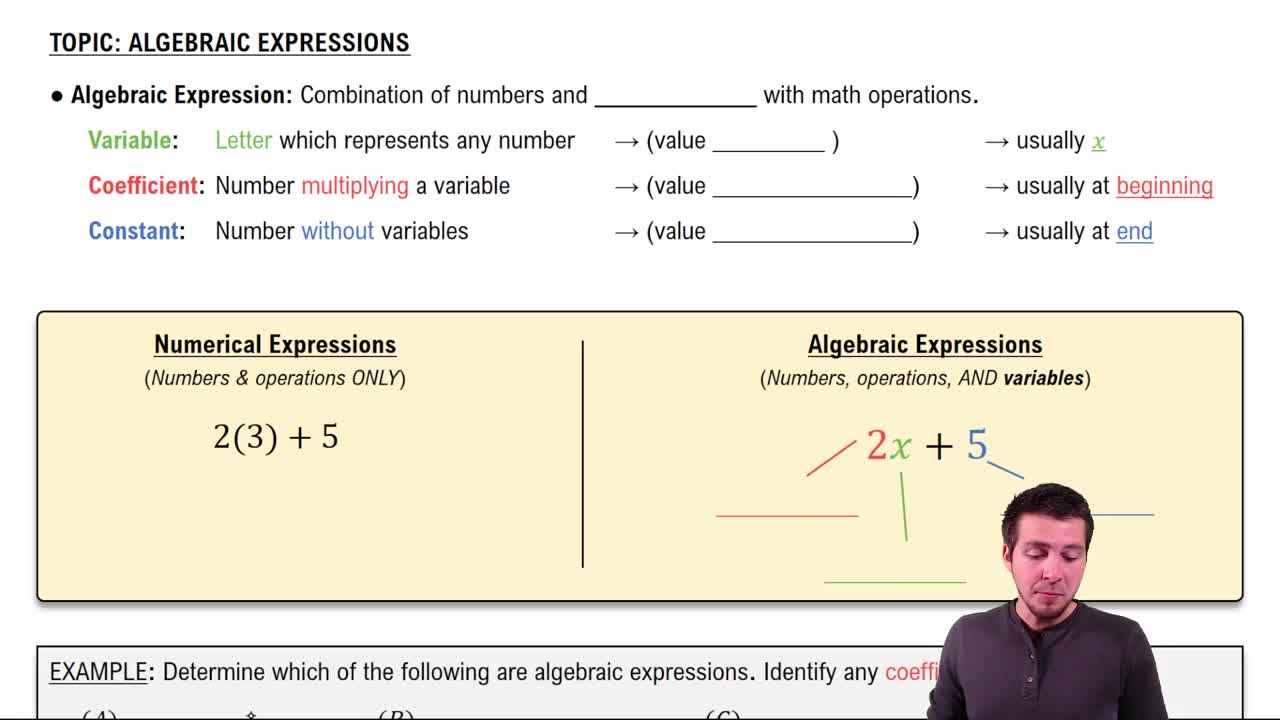
Algebraic Expressions and Variables

Representing unknown quantities with variables allows us to translate word problems into equations. Here, defining the width as a variable and expressing the length in terms of the width helps form an equation to solve.
Recommended video:
Guided course
05:09
Introduction to Algebraic Expressions

Solving Linear Equations

Once the equation is set up, solving linear equations involves isolating the variable to find its value. This process includes combining like terms and performing inverse operations to determine the dimensions of the shed.
Recommended video:
04:02
Solving Linear Equations with Fractions
Related Practice
Textbook Question

Identify each number as real, complex, pure imaginary, or nonreal com-plex. (More than one of these descriptions will apply.) 0

1198
views
Textbook Question

Use Choices A–D to answer each question. A. 3x2 - 17x - 6 = 0 B. (2x + 5)2 = 7 C. x2 + x = 12 D. (3x - 1)(x - 7) = 0 Only one of the equations is set up so that the values of a, b, and c can be determined immediately. Which one is it? Solve it.

750
views
Textbook Question

Use the following facts. If x represents an integer, then x+1 represents the next consecutive integer. If x represents an even integer, then x+2 represents the next consecutive even integer. If x represents an odd integer, then x+2 represents the next consecutive odd integer. Find two consecutive odd integers whose product is 63.

880
views
Textbook Question

Use the following facts. If x represents an integer, then x+1 represents the next consecutive integer. If x represents an even integer, then x+2 represents the next consecutive even integer. If x represents an odd integer, then x+2 represents the next consecutive odd integer. Find two consecutive even integers whose product is 168.

771
views
Textbook Question

Solve each equation. |7 - 3x| = 3

684
views
Textbook Question

Use the following facts. If x represents an integer, then x+1 represents the next consecutive integer. If x represents an even integer, then x+2 represents the next consecutive even integer. If x represents an odd integer, then x+2 represents the next consecutive odd integer. Find two consecutive even integers whose product is 224.

64
views