Ch. 5 - Systems and Matrices
Lial - College Algebra 13th Edition
Lial13th EditionCollege AlgebraISBN: 9780136881063Not the one you use?Change textbook
Chapter 6, Problem 109

Solve each problem. See Examples 5 and 9. Solve the system of equations (4), (5), and (6) from Example 9.
25x+40y+20z=220025x + 40y + 20z = 2200 (4)
4x+2y+3z=2804x + 2y + 3z = 280 (5)
3x+2y+z=1803x + 2y + z = 180 (6)

Verified step by step guidance
1
Start by writing down the system of equations clearly: \[25x + 40y + 20z = 2200\] \[4x + 2y + 3z = 280\] \[3x + 2y + z = 180\]
Choose two of the equations to eliminate one variable. For example, subtract equation (6) multiplied by an appropriate number from equation (5) multiplied by another number to eliminate variable \( y \). This will give you an equation with only \( x \) and \( z \).
Next, use the result from step 2 and one of the original equations (for example, equation (6)) to eliminate another variable, such as \( z \), to solve for \( x \) alone.
Once you have the value of \( x \), substitute it back into one of the two-variable equations from step 2 to find \( z \).
Finally, substitute the values of \( x \) and \( z \) into any of the original equations to solve for \( y \).

Verified video answer for a similar problem:

This video solution was recommended by our tutors as helpful for the problem above.
Video duration:
7m
Was this helpful?

Key Concepts

Here are the essential concepts you must grasp in order to answer the question correctly.

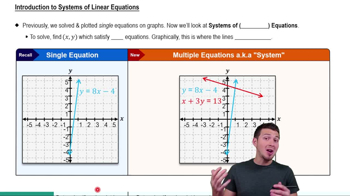
Systems of Linear Equations

A system of linear equations consists of multiple linear equations involving the same set of variables. The goal is to find values for these variables that satisfy all equations simultaneously. Understanding how to interpret and set up such systems is essential for solving them correctly.
Recommended video:
Guided course
4:27
Introduction to Systems of Linear Equations

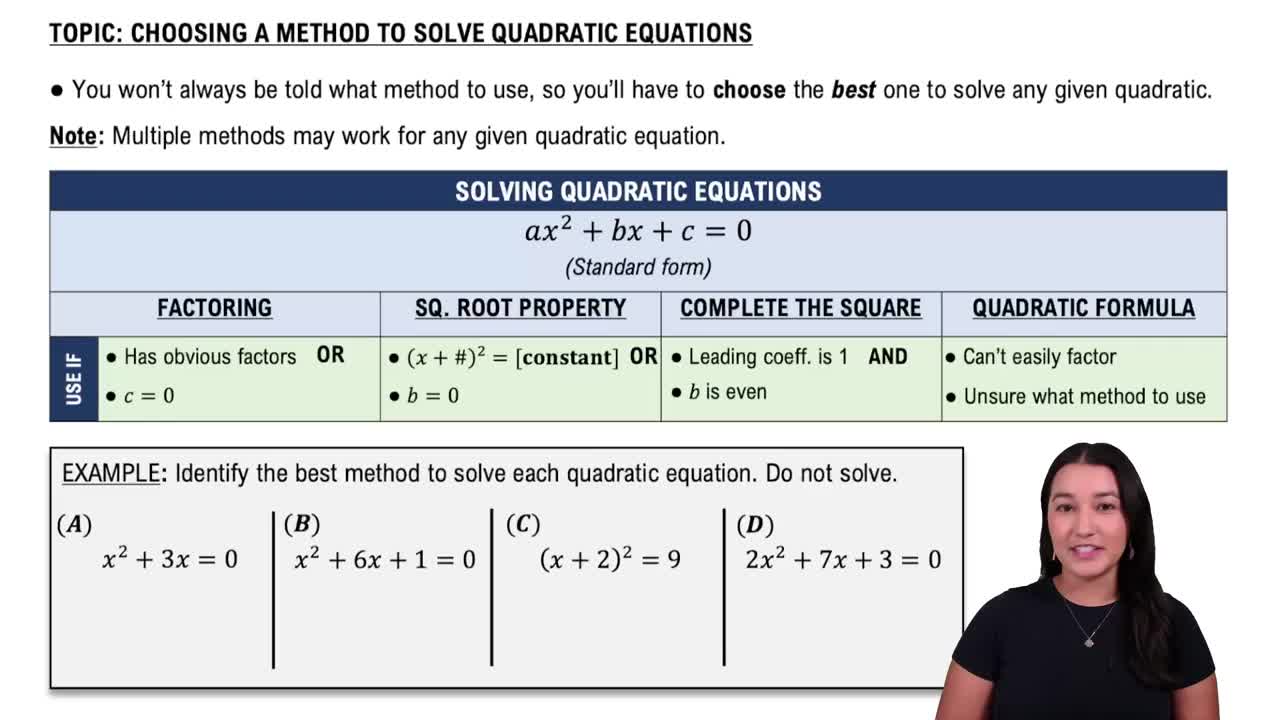
Methods for Solving Systems (Substitution, Elimination, and Matrix Methods)

Common techniques to solve systems include substitution, elimination, and using matrices (such as Gaussian elimination). These methods transform the system into simpler forms to isolate variables and find their values efficiently.
Recommended video:
04:03
Choosing a Method to Solve Quadratics

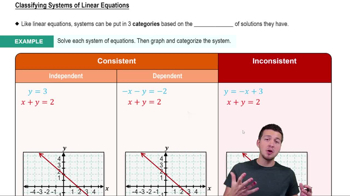
Checking Solutions for Consistency

After finding potential solutions, it is important to verify them by substituting back into the original equations. This ensures the solution satisfies all equations, confirming the system is consistent and the solution is correct.
Recommended video:
Guided course
6:57
Classifying Systems of Linear Equations