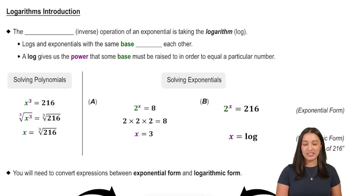
Step 1: Recognize that the equation \(7^x = 21\) involves an exponential function, and to solve for \(x\), we need to use logarithms.
Step 2: Take the natural logarithm (or common logarithm) of both sides of the equation: \(\ln(7^x) = \ln(21)\).
Step 3: Apply the logarithmic identity \(\ln(a^b) = b \cdot \ln(a)\) to the left side of the equation: \(x \cdot \ln(7) = \ln(21)\).
Step 4: Solve for \(x\) by dividing both sides of the equation by \(\ln(7)\): \(x = \frac{\ln(21)}{\ln(7)}\).
Step 5: The expression \(x = \frac{\ln(21)}{\ln(7)}\) gives the solution for \(x\) in terms of logarithms.
Verified video answer for a similar problem:
This video solution was recommended by our tutors as helpful for the problem above
Video duration:
1m
Play a video:
0 Comments
Key Concepts
Here are the essential concepts you must grasp in order to answer the question correctly.
Exponential Functions
Exponential functions are mathematical expressions in the form of f(x) = a * b^x, where 'a' is a constant, 'b' is the base, and 'x' is the exponent. In the equation 7ˣ = 21, we are dealing with an exponential function where the variable 'x' is in the exponent. Understanding the properties of exponential functions is crucial for solving equations involving them.
Logarithms are the inverse operations of exponentiation, allowing us to solve for the exponent in equations like 7ˣ = 21. The logarithm log_b(a) answers the question: to what exponent must the base 'b' be raised to produce 'a'? In this case, we can use logarithms to isolate 'x' by rewriting the equation in logarithmic form.
The properties of equality state that if two expressions are equal, then we can perform the same operation on both sides without changing the equality. This principle is essential when manipulating equations, such as applying logarithms to both sides of 7ˣ = 21 to solve for 'x'. Understanding these properties ensures that the solutions derived from the equations are valid.