Step 1: Start by isolating the term with the variable. Divide both sides of the equation by 5 to get x^3 = \(\frac{29}{5}\).
Step 2: To solve for x, take the cube root of both sides of the equation. This will give you x = \(\sqrt\)[3]{\(\frac{29}{5}\)}.
Step 3: Simplify the expression if possible. In this case, \(\sqrt\)[3]{\(\frac{29}{5}\)} is already in its simplest form.
Step 4: Consider the properties of cube roots. Remember that the cube root of a number can be positive or negative, but since we are dealing with real numbers, we focus on the principal (positive) root.
Step 5: Verify your solution by substituting x back into the original equation to ensure that both sides are equal.
Verified video answer for a similar problem:
This video solution was recommended by our tutors as helpful for the problem above
Video duration:
1m
Play a video:
0 Comments
Key Concepts
Here are the essential concepts you must grasp in order to answer the question correctly.
Exponential Equations
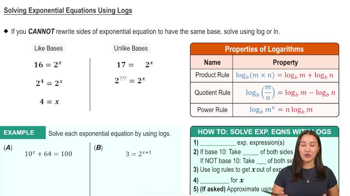
Exponential equations involve variables in the exponent, such as the equation 5(x³) = 29. To solve these equations, one typically isolates the exponential term and applies logarithmic functions to both sides, allowing for the extraction of the variable from the exponent.
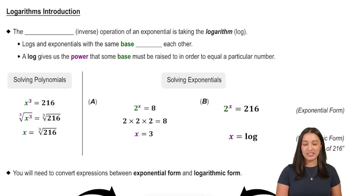
Logarithms are the inverse operations of exponentiation. They allow us to solve for the exponent in an equation. For example, if we have an equation in the form a^b = c, we can use logarithms to express b as log_a(c), which is essential for solving exponential equations.
Algebraic manipulation involves rearranging and simplifying equations to isolate the variable of interest. This includes operations such as addition, subtraction, multiplication, and division, as well as applying properties of equality to maintain balance in the equation while solving for the unknown.

 1:59 minutes
 Verified step by step guidance
 5:47
5:47