Step 1: Understand the equation. The equation given is \( \ln x = -1 \). This means we are looking for a value of \( x \) such that the natural logarithm of \( x \) equals \(-1\).
Step 2: Recall the definition of the natural logarithm. The natural logarithm \( \ln x \) is the power to which \( e \) (Euler's number, approximately 2.718) must be raised to obtain \( x \).
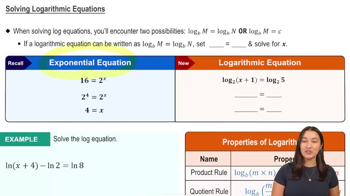
Step 3: Convert the logarithmic equation to an exponential form. The equation \( \ln x = -1 \) can be rewritten as \( x = e^{-1} \).
Step 4: Simplify the expression. The expression \( e^{-1} \) can be simplified to \( \frac{1}{e} \).
Step 5: Conclude the solution. The value of \( x \) that satisfies the equation \( \ln x = -1 \) is \( \frac{1}{e} \).
Verified video answer for a similar problem:
This video solution was recommended by our tutors as helpful for the problem above
Video duration:
2m
Play a video:
0 Comments
Key Concepts
Here are the essential concepts you must grasp in order to answer the question correctly.
Natural Logarithm
The natural logarithm, denoted as ln, is the logarithm to the base e, where e is approximately 2.71828. It is the inverse function of the exponential function, meaning that if y = ln(x), then x = e^y. Understanding the properties of natural logarithms is essential for solving equations involving ln.
The exponential function is a mathematical function denoted as e^x, which describes growth or decay processes. It is crucial for solving logarithmic equations, as converting a logarithmic equation to its exponential form allows for easier manipulation. For example, if ln(x) = -1, it can be rewritten as x = e^(-1).
Solving logarithmic equations involves isolating the variable by converting the logarithmic expression into its exponential form. This process often requires understanding the properties of logarithms, such as the product, quotient, and power rules. In the case of ln(x) = -1, applying the exponential function helps find the value of x.