
Ch. 52 - Community Ecology
Freeman - Biological Science 8th Edition
Freeman8th EditionBiological ScienceISBN: 9780138276263Not the one you use?Change textbook
Chapter 52, Problem 7

What is a disturbance? Consider the role of fire in a forest. Compare the consequences of high-frequency versus low-frequency fire, and high severity versus low severity of fire.

Verified step by step guidance
1
Step 1: Define disturbance: In ecology, a disturbance is a temporary change in environmental conditions that causes a pronounced change in an ecosystem. Disturbances can have profound immediate effects on ecosystems and can, consequently, greatly alter the natural community.
Step 2: Understand the role of fire in a forest: Fire is a natural disturbance in many ecosystems, including forests. It can help in the recycling of nutrients as it burns dead or decaying organic matter. Some plant species have even adapted to fire and require it for their seeds to germinate.
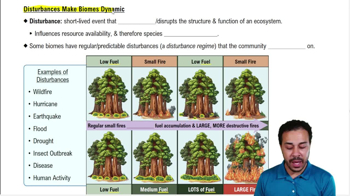
Step 3: Discuss high-frequency versus low-frequency fire: High-frequency fires occur often and can prevent the accumulation of dead vegetation, reducing the intensity of future fires. However, they can also prevent the establishment of certain tree species, leading to a change in the composition of the forest. Low-frequency fires occur less often, allowing for the accumulation of dead vegetation. This can lead to more intense fires when they do occur, which can have a more significant impact on the ecosystem.
Step 4: Discuss high severity versus low severity of fire: High severity fires burn hot and can kill most vegetation and wildlife, and alter the soil composition. They can lead to a longer recovery time for the ecosystem. Low severity fires burn less intensely and may not kill all vegetation or wildlife. They can help in the recycling of nutrients and stimulate the germination of certain plant species.
Step 5: Summarize the comparison: The frequency and severity of fires can greatly affect the composition and recovery of a forest ecosystem. High-frequency, low-severity fires can maintain certain ecosystems by preventing the accumulation of dead vegetation and stimulating the germination of fire-adapted species. Low-frequency, high-severity fires can lead to a longer recovery time for the ecosystem and a change in the species composition.

Verified video answer for a similar problem:

This video solution was recommended by our tutors as helpful for the problem above.
Video duration:
1m
Was this helpful?

Key Concepts

Here are the essential concepts you must grasp in order to answer the question correctly.

Disturbance Ecology

Disturbance ecology studies the effects of disturbances, such as fires, on ecosystems. Disturbances can alter habitat structure, species composition, and nutrient cycling. They can be natural, like wildfires, or anthropogenic, such as logging. Understanding disturbances helps in managing ecosystems and predicting their responses to environmental changes.
Recommended video:

Fire Regimes

Fire regimes refer to the patterns of fire occurrence, intensity, and severity in a given ecosystem over time. High-frequency fires occur more often and tend to be less severe, promoting certain species and preventing the accumulation of fuel. In contrast, low-frequency fires are less common but can be more intense, leading to significant ecological changes and potentially harmful effects on biodiversity.
Recommended video:
Guided course
02:09
Disturbances Make Biomes Dynamic

Ecological Succession

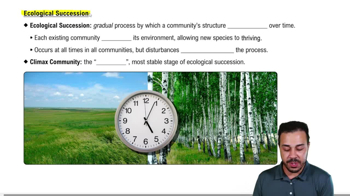
Ecological succession is the process by which ecosystems change and develop over time following a disturbance. After a fire, the area may undergo primary succession, where life begins anew, or secondary succession, where existing soil and organisms facilitate recovery. The type and frequency of fire influence the trajectory of succession, affecting species diversity and ecosystem resilience.
Recommended video:
Guided course
02:59
Ecological Succession