
Ch. 40 - Water and Electrolyte Balance in Animals
Freeman - Biological Science 8th Edition
Freeman8th EditionBiological ScienceISBN: 9780138276263Not the one you use?Change textbook
Chapter 40, Problem 1

Which of the following statements regarding fishes that live in fresh-water is/are correct? Select True or False for each statement.
T/F Water moves across the gills via osmosis until equilibrium is established, at which time the water molecules stop moving.
T/F They lose water to their environment primarily through the gills. They replace this water by drinking.
T/F Water enters epithelial cells in their gills via osmosis. Electrolytes leave the same cells via diffusion.
T/F They have specialized epithelia that actively pump electrolytes from the environment into the blood.

Verified step by step guidance
1
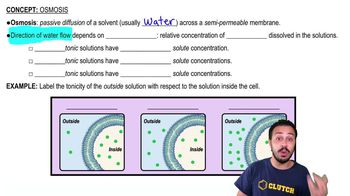
Understand the concept of osmosis: Osmosis is the movement of water across a semipermeable membrane from an area of low solute concentration to an area of high solute concentration. In biological systems, this process does not stop at equilibrium; rather, water continues to move in both directions at equal rates.
Consider the water balance in freshwater fish: Freshwater fish live in an environment where the water is less concentrated with solutes compared to their body fluids. Therefore, they tend to gain water through osmosis rather than lose it.
Analyze the movement of water and electrolytes in gill epithelial cells: Water enters the cells via osmosis due to the concentration gradient. Electrolytes, however, may leave the cells through diffusion, which is the movement of solutes from an area of high concentration to an area of low concentration.
Examine the role of specialized epithelia in electrolyte regulation: Freshwater fish have specialized cells in their gills that actively transport electrolytes from the environment into their bloodstream to maintain homeostasis, counteracting the passive loss of electrolytes.
Evaluate each statement based on the biological principles discussed: Use your understanding of osmosis, diffusion, and active transport to determine the accuracy of each statement regarding freshwater fish physiology.

Verified video answer for a similar problem:

This video solution was recommended by our tutors as helpful for the problem above.
Video duration:
2m
Was this helpful?

Key Concepts

Here are the essential concepts you must grasp in order to answer the question correctly.

Osmosis

Osmosis is the passive movement of water molecules across a semipermeable membrane from a region of lower solute concentration to a region of higher solute concentration. In freshwater fish, osmosis occurs as water moves into the fish's body due to the higher solute concentration inside compared to the surrounding water.
Recommended video:

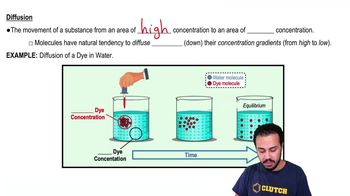
Diffusion

Diffusion is the passive movement of particles from an area of higher concentration to an area of lower concentration. In the context of freshwater fish, electrolytes may diffuse out of the fish's cells into the surrounding water, as the concentration of electrolytes is typically higher inside the fish than in the freshwater environment.
Recommended video:

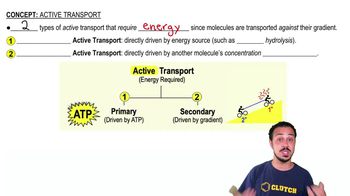
Active Transport

Active transport is the process by which cells move molecules across a membrane against their concentration gradient using energy, often in the form of ATP. Freshwater fish use specialized epithelial cells to actively transport electrolytes from the environment into their bloodstream, counteracting the loss of electrolytes through diffusion.
Recommended video:
Guided course
02:37
Active Transport