Ch. 33 - Viruses
Freeman - Biological Science 8th Edition
Freeman8th EditionBiological ScienceISBN: 9780138276263Not the one you use?Change textbook
Chapter 33, Problem 4

What features distinguish the seven major categories of viruses?

Verified step by step guidance
1
Understand that viruses are classified into seven major categories based on the Baltimore classification system, which is determined by their type of genetic material and replication strategy.
Step 1: Identify the type of nucleic acid in the virus. Viruses can have either DNA or RNA as their genetic material, and this is the first distinguishing feature.
Step 2: Determine whether the nucleic acid is single-stranded (ss) or double-stranded (ds). This is another key feature that helps classify the virus.
Step 3: For RNA viruses, assess whether the RNA is positive-sense (+) or negative-sense (-). Positive-sense RNA can be directly translated into proteins, while negative-sense RNA must first be converted into a complementary strand.
Step 4: Consider whether the virus uses reverse transcription. Some viruses, like retroviruses, use reverse transcriptase to convert RNA into DNA, which is then integrated into the host genome.
Step 5: Combine these features to place the virus into one of the seven categories: dsDNA viruses, ssDNA viruses, dsRNA viruses, (+)ssRNA viruses, (-)ssRNA viruses, RNA reverse-transcribing viruses, or DNA reverse-transcribing viruses.

Verified video answer for a similar problem:

This video solution was recommended by our tutors as helpful for the problem above.
Video duration:
50s
Was this helpful?

Key Concepts

Here are the essential concepts you must grasp in order to answer the question correctly.

Virus Classification

Viruses are classified into categories based on various criteria, including their genetic material (DNA or RNA), structure (enveloped or non-enveloped), and replication method. The seven major categories include DNA viruses, RNA viruses, retroviruses, and others, each with distinct characteristics that influence their behavior and interaction with host cells.
Recommended video:
Guided course
04:30
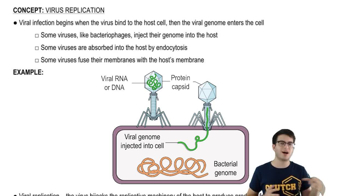
Virus Replication

Viral Structure

The structure of a virus is crucial for its classification and function. Viruses typically consist of a nucleic acid core surrounded by a protein coat called a capsid, and some have an additional lipid envelope. The arrangement of these components can vary significantly among the seven categories, affecting how viruses infect host cells and evade the immune system.
Recommended video:
Guided course
13:59
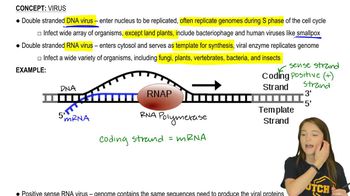
Viral Genetics

Host Range and Tropism

Host range refers to the variety of hosts that a virus can infect, while tropism indicates the specific types of cells or tissues within a host that a virus targets. Understanding these concepts is essential for distinguishing between virus categories, as different viruses have evolved to infect specific hosts and cell types, influencing their pathogenicity and transmission.
Recommended video:
Guided course
01:59
How Mountain Ranges Affect Climate