
Ch. 19 - Control of Gene Expression in Eukaryotes
Freeman - Biological Science 8th Edition
Freeman8th EditionBiological ScienceISBN: 9780138276263Not the one you use?Change textbook
Chapter 19, Problem 4

What is alternative splicing?
a. Phosphorylation that leads to different types of post-translational regulation
b. mRNA processing that leads to different combinations of exons being spliced together
c. Folding that leads to proteins with alternative conformations
d. The outcome of regulatory proteins that leads to changes in the life span of an mRNA

Verified step by step guidance
1
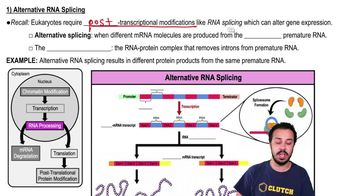
Understand the concept of alternative splicing: Alternative splicing is a process during gene expression where a single pre-mRNA transcript can be spliced in different ways to produce multiple mature mRNA variants. This allows a single gene to code for multiple proteins.
Eliminate incorrect options by analyzing their definitions: Option (a) refers to phosphorylation, which is a post-translational modification, not related to mRNA splicing. Option (c) refers to protein folding, which occurs after translation and is unrelated to mRNA processing. Option (d) refers to mRNA stability and degradation, which is also unrelated to splicing.
Focus on option (b): This option describes mRNA processing that results in different combinations of exons being joined together. This is the correct definition of alternative splicing.
Relate the concept to biological significance: Alternative splicing increases protein diversity without requiring additional genes. It plays a critical role in development, cell differentiation, and adaptation to environmental changes.
Conclude that the correct answer is option (b), as it accurately describes the process of alternative splicing in mRNA processing.

Verified video answer for a similar problem:

This video solution was recommended by our tutors as helpful for the problem above.
Video duration:
40s
Was this helpful?

Key Concepts

Here are the essential concepts you must grasp in order to answer the question correctly.

Alternative Splicing

Alternative splicing is a post-transcriptional process in which a single gene can lead to multiple mRNA variants by including or excluding certain exons. This mechanism allows for the generation of diverse protein isoforms from a single gene, significantly increasing the complexity of gene expression and protein function in eukaryotic cells.
Recommended video:
Guided course
05:17
1) Alternative RNA Splicing

Exons and Introns

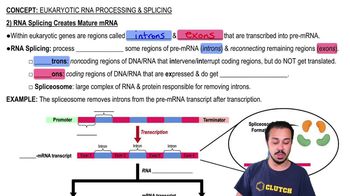
Exons are the coding regions of a gene that are retained in the final mRNA transcript, while introns are non-coding regions that are removed during mRNA processing. The arrangement and selection of exons during splicing determine the specific protein product synthesized, influencing cellular functions and responses.
Recommended video:
Guided course
08:44
2) RNA Splicing Creates Mature mRNA

mRNA Processing

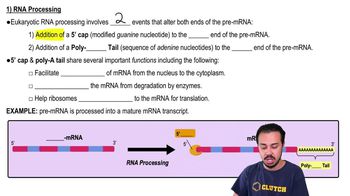
mRNA processing refers to the modifications that pre-mRNA undergoes before it becomes a mature mRNA molecule. This includes capping, polyadenylation, and splicing, which are essential for the stability, transport, and translation of mRNA, ultimately affecting gene expression and protein synthesis.
Recommended video:
Guided course
04:19
1) RNA Processing