
Ch. 55 - Ecosystems and Restoration Ecology
Campbell - Campbell Biology 11th Edition
Urry11th EditionCampbell BiologyISBN: 9789357423311Not the one you use?Change textbook
Chapter 55, Problem 8

If you applied a fungicide to a cornfield, what would you expect to happen to the rate of decomposition and net ecosystem production (NEP)?
a. Both decomposition rate and NEP would decrease.
b. Neither would change.
c. Decomposition rate would increase and NEP would decrease.
d. Decomposition rate would decrease and NEP would increase.

Verified step by step guidance
1
Understand the role of fungi in an ecosystem: Fungi are decomposers, meaning they break down organic matter, recycling nutrients back into the ecosystem. This process is crucial for maintaining the balance of nutrients in the soil.
Consider the effect of a fungicide: A fungicide is a chemical that kills fungi. Applying it to a cornfield would likely reduce the population of fungi, thereby affecting their ability to decompose organic matter.
Analyze the impact on decomposition rate: With fewer fungi present due to the fungicide, the rate of decomposition would decrease because there are fewer organisms to break down organic material.
Evaluate the effect on net ecosystem production (NEP): NEP is the balance between the total amount of carbon fixed by photosynthesis and the total amount of carbon released by respiration and decomposition. If decomposition decreases, less carbon is released back into the atmosphere, potentially increasing NEP.
Conclude the expected changes: Based on the analysis, applying a fungicide would likely lead to a decrease in decomposition rate and an increase in NEP, aligning with option d.

Verified video answer for a similar problem:

This video solution was recommended by our tutors as helpful for the problem above.
Video duration:
1m
Was this helpful?

Key Concepts

Here are the essential concepts you must grasp in order to answer the question correctly.

Decomposition Rate

Decomposition rate refers to the speed at which organic matter is broken down by decomposers, such as fungi and bacteria, into simpler substances. This process is crucial for nutrient cycling in ecosystems, as it releases nutrients back into the soil, making them available for plant uptake. Applying a fungicide can reduce the population of fungi, potentially slowing down the decomposition rate.
Recommended video:
Guided course
07:08
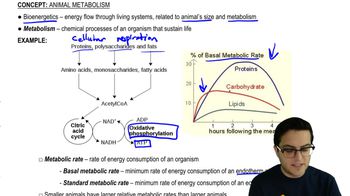
Metabolic Rate

Net Ecosystem Production (NEP)

Net Ecosystem Production (NEP) is the balance between the total amount of carbon dioxide absorbed by photosynthesis and the carbon dioxide released through respiration and decomposition in an ecosystem. NEP indicates the net gain or loss of carbon in an ecosystem, reflecting its productivity. A decrease in decomposition due to fungicide application might lead to an increase in NEP, as less carbon is released back into the atmosphere.
Recommended video:
Guided course
07:47
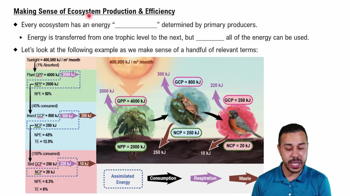
Making Sense of Ecosystem Production & Efficiency

Impact of Fungicides on Ecosystems

Fungicides are chemicals used to kill or inhibit the growth of fungi, which play a vital role in decomposition and nutrient cycling. Their application can disrupt the balance of ecosystems by reducing fungal activity, affecting decomposition rates and potentially altering ecosystem productivity. Understanding these impacts is essential for predicting changes in ecosystem functions, such as NEP, following fungicide use.
Recommended video:
Guided course
03:35
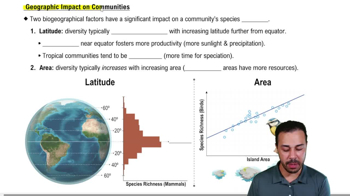
Geographic Impact on Communities