
Ch. 55 - Ecosystems and Restoration Ecology
Campbell - Campbell Biology 11th Edition
Urry11th EditionCampbell BiologyISBN: 9789357423311Not the one you use?Change textbook
Chapter 55, Problem 7

Which of the following would be considered an example of bioremediation?
a. Adding nitrogen-fixing microorganisms to a degraded ecosystem to increase nitrogen availability
b. Using a bulldozer to regrade a strip mine
c. Reconfiguring the channel of a river
d. Adding seeds of a chromium-accumulating plant to soil contaminated by chromium

Verified step by step guidance
1
Understand the concept of bioremediation: Bioremediation is the process of using living organisms, such as plants, bacteria, or fungi, to remove or neutralize contaminants from a polluted area.
Evaluate option a: Adding nitrogen-fixing microorganisms to a degraded ecosystem involves using living organisms to improve soil quality by increasing nitrogen availability, which aligns with the concept of bioremediation.
Evaluate option b: Using a bulldozer to regrade a strip mine is a mechanical process and does not involve living organisms, so it does not fit the definition of bioremediation.
Evaluate option c: Reconfiguring the channel of a river is a structural change to the environment and does not involve the use of living organisms to remove contaminants, thus it is not bioremediation.
Evaluate option d: Adding seeds of a chromium-accumulating plant to soil contaminated by chromium involves using plants to absorb and accumulate chromium, which is a direct application of bioremediation.

Verified video answer for a similar problem:

This video solution was recommended by our tutors as helpful for the problem above.
Video duration:
2m
Was this helpful?

Key Concepts

Here are the essential concepts you must grasp in order to answer the question correctly.

Bioremediation

Bioremediation is the process of using living organisms, such as microbes or plants, to remove or neutralize contaminants from a polluted area. This environmentally friendly technique leverages natural processes to clean up soil, water, and air, making it a sustainable alternative to traditional methods like chemical treatments or physical removal.

Nitrogen Fixation

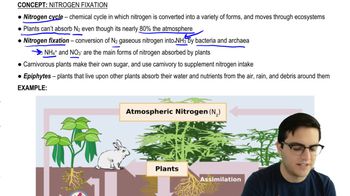
Nitrogen fixation is a biological process where certain microorganisms convert atmospheric nitrogen (N2) into ammonia (NH3), a form that plants can absorb and use for growth. This process is crucial for maintaining soil fertility and is often employed in bioremediation to enhance nutrient availability in degraded ecosystems.
Recommended video:
Guided course
06:31
Nitrogen Cycle

Phytoremediation

Phytoremediation is a type of bioremediation that involves using plants to absorb, concentrate, and/or detoxify pollutants from soil and water. Certain plants, known as hyperaccumulators, can take up heavy metals like chromium, making them effective for cleaning contaminated sites. This method is cost-effective and environmentally sustainable.