
Ch. 45 - Hormones and the Endocrine System
Campbell - Campbell Biology 11th Edition
Urry11th EditionCampbell BiologyISBN: 9789357423311Not the one you use?Change textbook
Chapter 45, Problem 8

In mammals, milk production by mammary glands is controlled by prolactin and prolactin-releasing hormone. Draw a simple sketch of this pathway, including glands, tissues, hormones, routes for hormone movement, and effects.

Verified step by step guidance
1
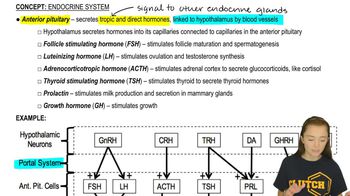
Identify the hypothalamus as the starting point of the pathway. It releases Thyrotropin-Releasing Hormone (TRH), which is involved in the regulation of prolactin secretion.
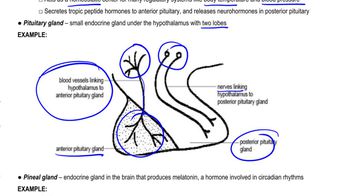
Recognize that TRH travels to the anterior pituitary gland, which is labeled as 'A' in the diagram. The anterior pituitary gland is responsible for producing and releasing prolactin into the bloodstream.
Understand that prolactin, once released from the anterior pituitary, enters the bloodstream, as depicted by the blood vessel in the diagram.
Note that prolactin travels through the bloodstream to reach the mammary glands, which are labeled as 'C' in the diagram. Prolactin stimulates the mammary glands to produce milk.
Conclude that the pathway involves the hypothalamus releasing TRH, which stimulates the anterior pituitary to release prolactin, leading to milk production in the mammary glands.

Verified video answer for a similar problem:

This video solution was recommended by our tutors as helpful for the problem above.
Video duration:
1m
Was this helpful?

Key Concepts

Here are the essential concepts you must grasp in order to answer the question correctly.

Hypothalamus and TRH

The hypothalamus is a crucial brain region that regulates various physiological processes, including hormone release. It secretes thyrotropin-releasing hormone (TRH), which stimulates the anterior pituitary gland to produce prolactin. This hormone is essential for initiating and maintaining milk production in mammals. The hypothalamus acts as a control center, integrating signals to modulate hormone levels.
Recommended video:
Guided course
03:34
Hypothalamus and Pituitary

Prolactin and Anterior Pituitary Gland

Prolactin is a hormone produced by the anterior pituitary gland, a small gland located at the base of the brain. It plays a vital role in lactation by promoting milk production in the mammary glands. The release of prolactin is regulated by TRH from the hypothalamus and is crucial for the development and function of mammary tissues during and after pregnancy.
Recommended video:
Guided course
13:19
Anterior and Posterior Pituitary

Mammary Glands and Milk Production

Mammary glands are specialized organs in mammals responsible for producing milk to nourish offspring. Prolactin stimulates these glands to synthesize and secrete milk, a process essential for the survival and growth of newborns. The pathway involves the transport of prolactin through the bloodstream to the mammary tissues, where it exerts its effects, ensuring adequate milk supply.
Recommended video:
Guided course
04:36
Primary Production in Aquatic Ecosystems