
Ch. 21 - Genomes and Their Evolution
Campbell - Campbell Biology 11th Edition
Urry11th EditionCampbell BiologyISBN: 9789357423311Not the one you use?Change textbook
Chapter 21, Problem 4f

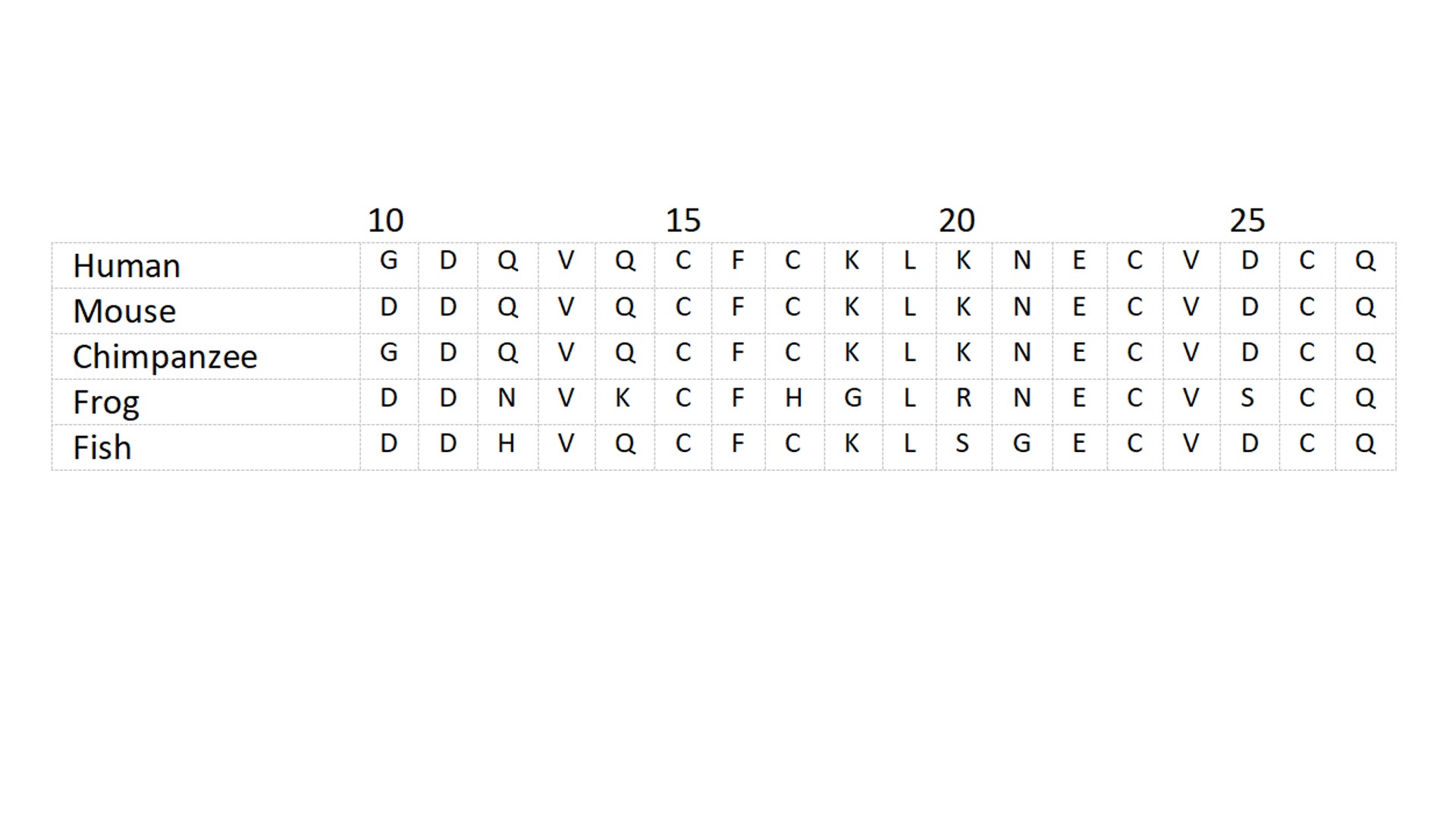
Use a highlighter to color any amino acid that varies among the species. (Color that amino acid in all sequences.)
e. Primates and rodents diverged between 60 and 100 million years ago, and chimpanzees and humans about 6 million years ago. Compare the amino acid differences between the mouse and the C, G, R species with those between the human and the C, G, R species. What can you conclude?

Verified step by step guidance
1
Identify the amino acid sequences for each species: Human, Mouse, Chimpanzee, Frog, and Fish.
Compare the amino acid sequences of the Mouse with the Chimpanzee, Frog, and Fish to identify any differences. Highlight these differences.
Compare the amino acid sequences of the Human with the Chimpanzee, Frog, and Fish to identify any differences. Highlight these differences.
Count the number of amino acid differences between the Mouse and each of the C (Chimpanzee), G (Frog), and R (Fish) species.
Count the number of amino acid differences between the Human and each of the C (Chimpanzee), G (Frog), and R (Fish) species. Compare these counts to those obtained for the Mouse to draw conclusions about evolutionary divergence.

Verified video answer for a similar problem:

This video solution was recommended by our tutors as helpful for the problem above.
Video duration:
2m
Was this helpful?

Key Concepts

Here are the essential concepts you must grasp in order to answer the question correctly.

Amino Acid Sequence Comparison

Amino acid sequence comparison involves analyzing the differences and similarities in the sequences of proteins across different species. This can reveal evolutionary relationships and functional similarities. In the given table, comparing sequences helps identify which amino acids vary among species, providing insights into evolutionary divergence and protein function.
Recommended video:

Evolutionary Divergence

Evolutionary divergence refers to the process by which two or more species evolve different traits from a common ancestor. This is often reflected in genetic and protein sequence differences. The divergence times mentioned (e.g., primates and rodents diverging 60-100 million years ago) help contextualize the observed amino acid differences, indicating how long species have been evolving separately.
Recommended video:
02:45
History of Evolutionary Theory Example 1

Phylogenetic Relationships

Phylogenetic relationships describe the evolutionary connections between species, often depicted as a tree. These relationships can be inferred from genetic or protein sequence data. In this context, comparing the amino acid sequences of humans, mice, chimpanzees, frogs, and fish can help deduce their evolutionary proximity, with closer sequences suggesting more recent common ancestry.
Recommended video:
04:13
Building Phylogenetic Trees Example 2