


Ch. 21 - Genomes and Their Evolution
Campbell - Campbell Biology 11th Edition
Urry11th EditionCampbell BiologyISBN: 9789357423311Not the one you use?Change textbook
Chapter 21, Problem 4e

Use a highlighter to color any amino acid that varies among the species. (Color that amino acid in all sequences.)
d. In the M sequence, circle the amino acid(s) that differ from the C, G, R sequences, and draw a square around those that differ from the H sequence.

Verified step by step guidance
1
Identify the amino acid sequences for each species: Human, Mouse, Chimpanzee, Frog, and Fish.
Compare each position across all species to find amino acids that vary. Highlight these positions in all sequences.
For the M sequence (Mouse), compare each amino acid with the C (Chimpanzee), G (Frog), and R (Fish) sequences.
Circle the amino acids in the Mouse sequence that differ from the Chimpanzee, Frog, and Fish sequences.
Draw a square around the amino acids in the Mouse sequence that differ from the Human sequence.

Verified video answer for a similar problem:

This video solution was recommended by our tutors as helpful for the problem above.
Video duration:
2m
Was this helpful?

Key Concepts

Here are the essential concepts you must grasp in order to answer the question correctly.

Amino Acid Sequence Alignment

Amino acid sequence alignment is a method used to identify regions of similarity that may indicate functional, structural, or evolutionary relationships between the sequences. In this context, the alignment helps to compare the sequences from different species to identify variations, which are crucial for understanding evolutionary differences and functional implications.
Recommended video:

Protein Structure and Function

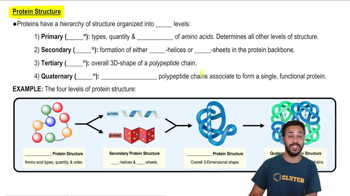
Proteins are composed of amino acids, and their sequence determines their three-dimensional structure and function. Variations in amino acid sequences can lead to changes in protein structure, potentially affecting its function. Understanding these variations is essential for studying how different species adapt and evolve at the molecular level.
Recommended video:
Guided course
08:02
Protein Structure

Evolutionary Biology

Evolutionary biology examines the origins and changes in the diversity of life over time. By comparing amino acid sequences across species, scientists can infer evolutionary relationships and trace lineage divergences. This concept is crucial for understanding how genetic variations contribute to the adaptation and evolution of species.
Recommended video:
02:45
History of Evolutionary Theory Example 1