Ch. 1 - Evolution, the Themes of Biology, and Scientific Inquiry
Campbell - Campbell Biology 12th Edition
Urry12th EditionCampbell BiologyISBN: 9785794169850Not the one you use?Change textbook
Chapter 1, Problem 8

Draw a biological hierarchy similar to the one in Figure 1.3 but using a coral reef as the ecosystem, a fish as the organism, its stomach as the organ, and DNA as the molecule. Include all levels in the hierarchy.
<IMAGE>

Verified step by step guidance
1
Begin by understanding the concept of biological hierarchy, which organizes biological structures from the smallest to the largest scale. This hierarchy typically includes molecules, organelles, cells, tissues, organs, organ systems, organisms, populations, communities, ecosystems, and the biosphere.
Start with the smallest level: DNA as the molecule. DNA is the genetic material that carries information necessary for the growth, development, and functioning of living organisms.
Next, consider the stomach of the fish as the organ. An organ is a group of tissues that work together to perform a specific function. The stomach is responsible for digestion in the fish.
Move to the organism level, which in this case is the fish. An organism is an individual living entity that can carry out life processes independently.
Finally, consider the coral reef as the ecosystem. An ecosystem includes all the living organisms in a particular area, along with the non-living components of the environment, interacting as a system.

Verified video answer for a similar problem:

This video solution was recommended by our tutors as helpful for the problem above.
Video duration:
3m
Was this helpful?

Key Concepts

Here are the essential concepts you must grasp in order to answer the question correctly.

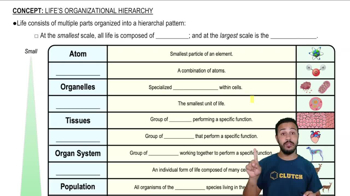
Biological Hierarchy

Biological hierarchy refers to the organization of living systems, from the smallest to the largest scale. It typically includes levels such as molecules, organelles, cells, tissues, organs, organisms, populations, communities, ecosystems, and the biosphere. Understanding this hierarchy helps in comprehending how complex biological systems are structured and function.
Recommended video:
Guided course
09:50
Life's Organizational Hierarchy

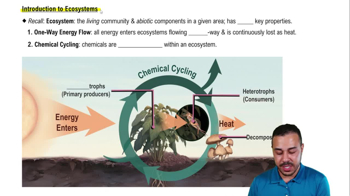
Ecosystem

An ecosystem is a community of living organisms interacting with their physical environment. In the context of a coral reef, it includes various species like fish, corals, and other marine life, along with abiotic factors such as water, sunlight, and minerals. Ecosystems are dynamic and involve complex interactions that sustain life and maintain ecological balance.
Recommended video:
Guided course
04:07
Introduction to Ecosystems

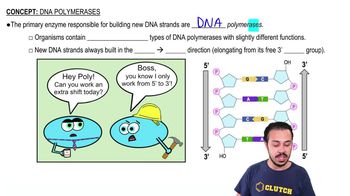
DNA as a Molecule

DNA, or deoxyribonucleic acid, is a molecule that carries genetic information essential for the growth, development, functioning, and reproduction of all living organisms. It is composed of nucleotides arranged in a double helix structure. DNA is crucial for heredity and is found in the cells of organisms, playing a key role in biological processes and the hierarchy of life.
Recommended video:
Guided course
04:01
DNA Polymerases