In terms of structure, how do channel proteins differ from carrier proteins?
Verified step by step guidance
1
Channel proteins form pores in the cell membrane, allowing specific molecules or ions to pass through by diffusion, while carrier proteins bind to the molecules they transport and undergo a conformational change to move the molecules across the membrane.
Channel proteins typically allow the passage of ions or water molecules and are often gated, meaning they can open or close in response to certain stimuli, whereas carrier proteins are more selective and transport specific molecules like glucose or amino acids.
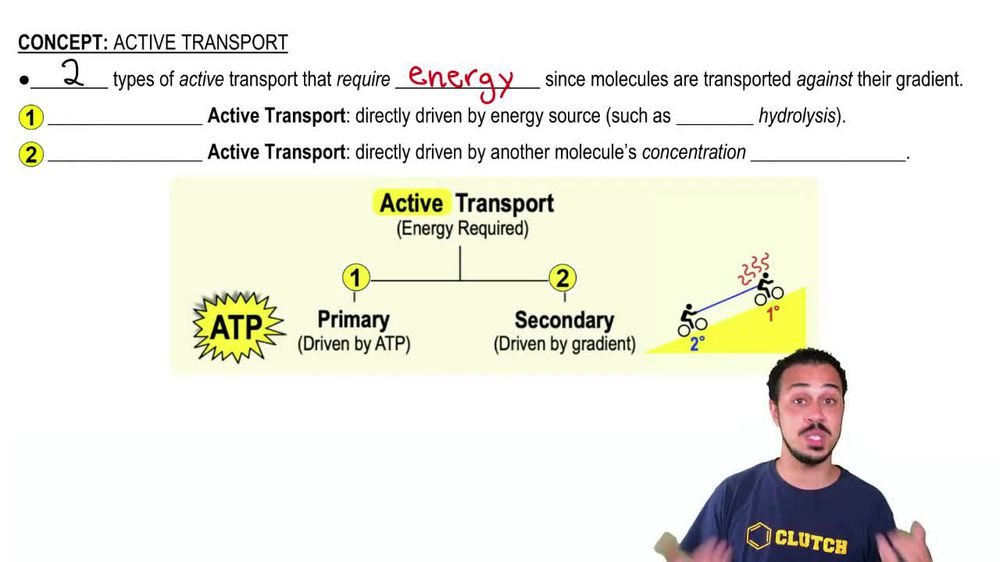
Channel proteins facilitate passive transport, meaning substances move along their concentration gradient without the use of cellular energy (ATP), while carrier proteins can facilitate both passive and active transport, the latter requiring energy to move substances against their concentration gradient.
The structure of channel proteins is often a tunnel-like formation that spans the lipid bilayer, whereas carrier proteins have a more complex structure that changes shape to shuttle the bound substrate across the membrane.
Channel proteins are integral membrane proteins that provide a hydrophilic pathway for the passage of ions and small molecules, while carrier proteins are also integral but work by binding to the substrate and undergoing a series of conformational changes to transport the substrate across the membrane.
Verified video answer for a similar problem:
This video solution was recommended by our tutors as helpful for the problem above
Video duration:
1m
Play a video:
0 Comments
Key Concepts
Here are the essential concepts you must grasp in order to answer the question correctly.
Channel Proteins
Channel proteins are integral membrane proteins that form pores or channels in the cell membrane, allowing specific ions or molecules to pass through by diffusion. They are typically selective for particular substances and can be gated, meaning they open or close in response to certain stimuli, facilitating rapid transport across the membrane.
Carrier proteins, unlike channel proteins, bind to specific molecules and undergo a conformational change to transport these substances across the membrane. They can facilitate both passive transport, where substances move down their concentration gradient, and active transport, which requires energy to move substances against their gradient.
Transport mechanisms refer to the various ways substances move across cell membranes, including passive and active transport. Understanding these mechanisms is crucial for distinguishing between channel and carrier proteins, as they utilize different processes to facilitate the movement of molecules, impacting cellular function and homeostasis.

 1:51 minutes
 Verified step by step guidance
 02:50
02:50