Facilitated diffusion across a membrane requires ______________ and moves a solute ______________ its concentration gradient.a. transport proteins . . . up (against)b. transport proteins . . . downc. energy and transport proteins . . . upd. energy and transport proteins . . . down
Verified step by step guidance
1
Identify the process: Facilitated diffusion is a type of passive transport.
Understand the role of transport proteins: Facilitated diffusion requires transport proteins to help move substances across the cell membrane.
Determine the direction of movement: In facilitated diffusion, solutes move down their concentration gradient, from an area of higher concentration to an area of lower concentration.
Recognize the energy requirement: Facilitated diffusion does not require energy input, as it is a passive process.
Match the correct option: Based on the understanding of facilitated diffusion, select the option that correctly describes the process.
Verified video answer for a similar problem:
This video solution was recommended by our tutors as helpful for the problem above
Video duration:
2m
Play a video:
0 Comments
Key Concepts
Here are the essential concepts you must grasp in order to answer the question correctly.
Facilitated Diffusion
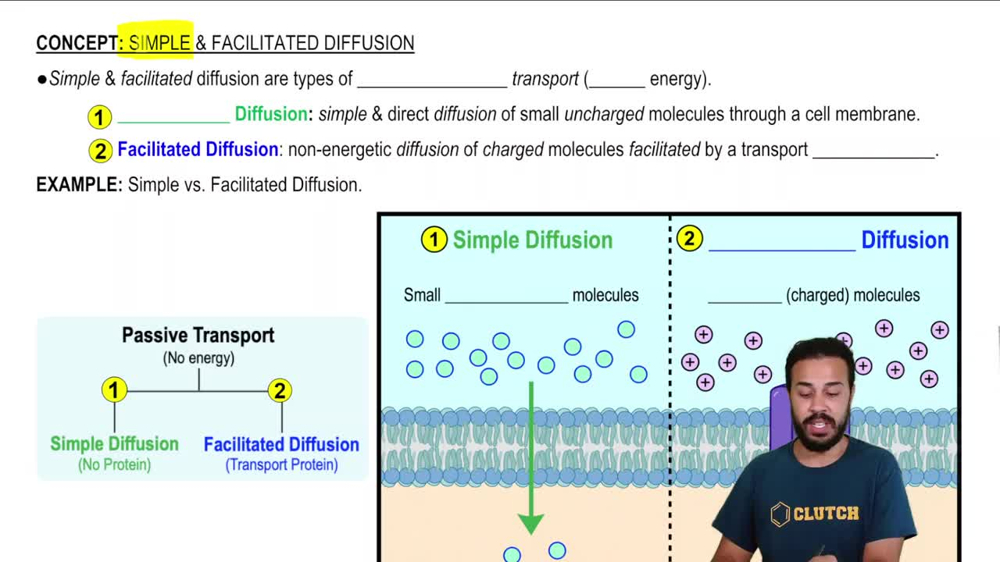
Facilitated diffusion is a passive transport process that allows substances to cross membranes with the assistance of special proteins. Unlike simple diffusion, which occurs directly through the lipid bilayer, facilitated diffusion requires specific transport proteins that help move molecules across the membrane without the expenditure of energy.
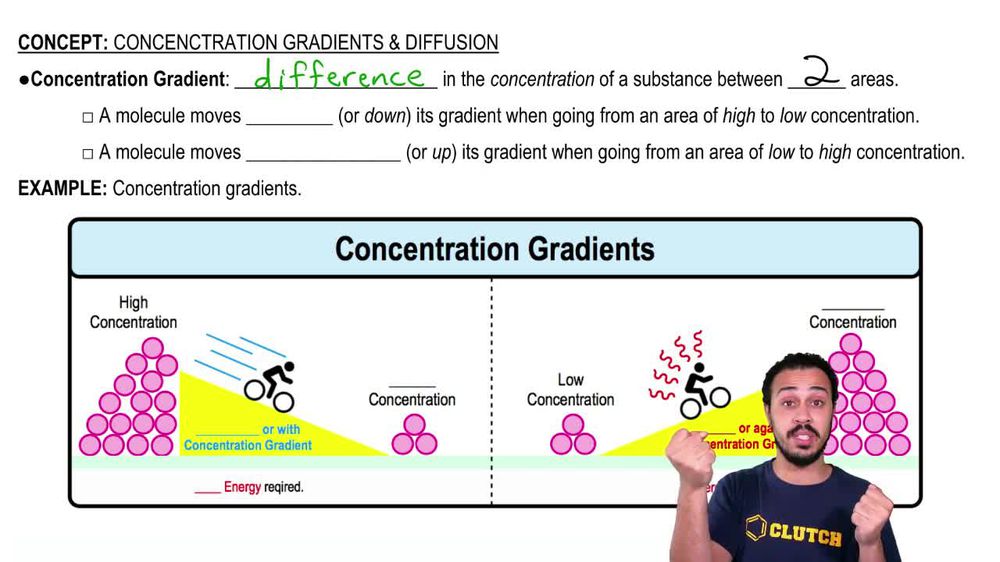
A concentration gradient refers to the difference in the concentration of a substance across a space or membrane. In biological systems, substances tend to move from areas of higher concentration to areas of lower concentration, which is known as moving down the concentration gradient. This process is crucial for maintaining cellular homeostasis.
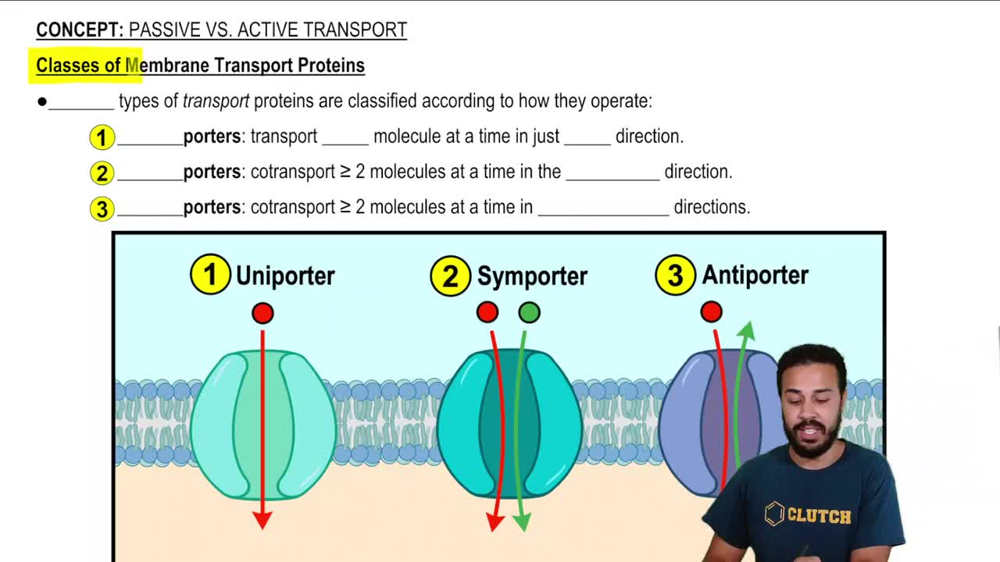
Transport proteins are integral membrane proteins that facilitate the movement of ions and molecules across the cell membrane. They can be classified into channels and carriers, with channels allowing specific molecules to pass through while carriers undergo conformational changes to transport substances. These proteins are essential for processes like facilitated diffusion.

 2:33 minutes
 Verified step by step guidance
 04:59
04:59