Ch. 1 - Trigonometric Functions
Lial - Trigonometry 12th Edition
Lial12th EditionTrigonometryISBN: 9780136552161Not the one you use?Change textbook
Chapter 2, Problem 3.73

Find each exact function value. See Example 3.
sin π/2

Verified step by step guidance
1
Identify the angle given in the problem, which is \( \frac{\pi}{2} \).
Recognize that \( \frac{\pi}{2} \) radians is equivalent to 90 degrees.
Recall that the sine function, \( \sin \theta \), gives the y-coordinate of the point on the unit circle corresponding to the angle \( \theta \).
On the unit circle, the point corresponding to 90 degrees (or \( \frac{\pi}{2} \) radians) is (0, 1).
Therefore, the sine of \( \frac{\pi}{2} \) is the y-coordinate of this point, which is 1.

Verified video answer for a similar problem:

This video solution was recommended by our tutors as helpful for the problem above.
Was this helpful?

Key Concepts

Here are the essential concepts you must grasp in order to answer the question correctly.

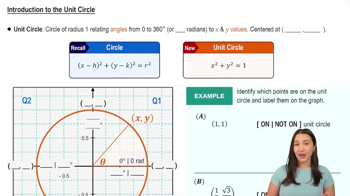
Unit Circle

The unit circle is a circle with a radius of one centered at the origin of a coordinate plane. It is fundamental in trigonometry as it provides a geometric interpretation of the sine, cosine, and tangent functions. The coordinates of points on the unit circle correspond to the cosine and sine values of angles measured in radians, making it essential for evaluating trigonometric functions like sin(π/2).
Recommended video:
06:11
Introduction to the Unit Circle

Trigonometric Functions

Trigonometric functions relate the angles of a triangle to the lengths of its sides. The primary functions include sine, cosine, and tangent, which are defined based on the ratios of the sides of a right triangle. For example, the sine function is defined as the ratio of the length of the opposite side to the hypotenuse. Understanding these functions is crucial for finding exact values like sin(π/2).
Recommended video:
6:04
Introduction to Trigonometric Functions

Exact Values of Trigonometric Functions

Exact values of trigonometric functions refer to specific values that can be determined without approximation. For common angles such as 0, π/6, π/4, π/3, and π/2, these values are well-known and can be derived from the unit circle. For instance, sin(π/2) equals 1, which is an exact value that can be easily recalled when solving trigonometric problems.
Recommended video:
6:04
Introduction to Trigonometric Functions