Ch. 5 - Complex Numbers, Polar Coordinates and Parametric Equations
Blitzer - Trigonometry 3rd Edition
Blitzer3rd EditionTrigonometryISBN: 9780137316601Not the one you use?Change textbook
Chapter 5, Problem 43

In Exercises 37–52, perform the indicated operations and write the result in standard form. __ (−3 − √−7)²

Verified step by step guidance
1
Recognize that the expression involves a complex number because of the term \( \sqrt{-7} \). Recall that \( \sqrt{-7} = \sqrt{7}i \), where \( i \) is the imaginary unit with the property \( i^2 = -1 \). So rewrite the expression as \( (-3 - \sqrt{7}i)^2 \).
Use the formula for squaring a binomial: \( (a - b)^2 = a^2 - 2ab + b^2 \). Here, \( a = -3 \) and \( b = \sqrt{7}i \).
Calculate each term separately: \( a^2 = (-3)^2 \), \( -2ab = -2 \times (-3) \times (\sqrt{7}i) \), and \( b^2 = (\sqrt{7}i)^2 \).
Simplify each term carefully, remembering that \( i^2 = -1 \). This will help convert the imaginary squared term into a real number.
Combine the simplified terms to write the result in standard form \( a + bi \), where \( a \) and \( b \) are real numbers.

Verified video answer for a similar problem:

This video solution was recommended by our tutors as helpful for the problem above.
Video duration:
4m
Was this helpful?

Key Concepts

Here are the essential concepts you must grasp in order to answer the question correctly.

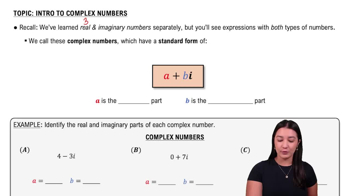
Complex Numbers and Imaginary Unit

Complex numbers consist of a real part and an imaginary part, expressed as a + bi, where i is the imaginary unit with the property i² = -1. Understanding how to handle the square root of negative numbers, such as √-7 = i√7, is essential for working with complex expressions.
Recommended video:
3:31
Introduction to Complex Numbers

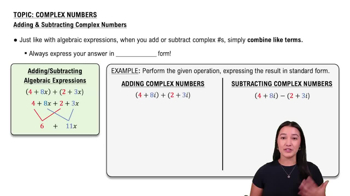
Algebraic Operations on Complex Numbers

Performing operations like addition, subtraction, multiplication, and exponentiation on complex numbers requires applying algebraic rules while treating i as a variable with the special property i² = -1. Squaring a complex binomial involves expanding using the distributive property or FOIL method.
Recommended video:
3:18
Adding and Subtracting Complex Numbers

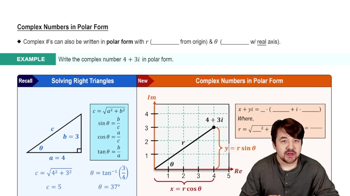
Standard Form of a Complex Number

The standard form of a complex number is a + bi, where a and b are real numbers. After performing operations, the result should be simplified and expressed clearly in this form, separating the real and imaginary parts for clarity and further use.
Recommended video:
04:47
Complex Numbers In Polar Form