Ch. 4 - Laws of Sines and Cosines; Vectors
Blitzer - Trigonometry 3rd Edition
Blitzer3rd EditionTrigonometryISBN: 9780137316601Not the one you use?Change textbook
Chapter 4, Problem 1a

In Exercises 1–4, u and v have the same direction. In each exercise: Find ||u||.
Graph showing vectors a and b with coordinates and directions in a Cartesian plane.

Verified step by step guidance
1
Identify the vectors u and v from the graph. Since u and v have the same direction, they are scalar multiples of each other.
Calculate the components of vector a: from (-17, 15) to (15, 19), so \( a_x = 15 - (-17) = 32 \) and \( a_y = 19 - 15 = 4 \).
Calculate the components of vector b: from (-2, 7) to (30, 11), so \( b_x = 30 - (-2) = 32 \) and \( b_y = 11 - 7 = 4 \).
Since vectors a and b have the same direction, find the magnitude of vector u (which corresponds to vector a or b) using the formula for the magnitude of a vector: \( ||u|| = \sqrt{(x_2 - x_1)^2 + (y_2 - y_1)^2} \).
Substitute the components into the magnitude formula: \( ||u|| = \sqrt{(32)^2 + (4)^2} \) and simplify under the square root to find the magnitude.

Verified video answer for a similar problem:

This video solution was recommended by our tutors as helpful for the problem above.
Video duration:
6m
Was this helpful?

Key Concepts

Here are the essential concepts you must grasp in order to answer the question correctly.

Vector Magnitude (Norm)

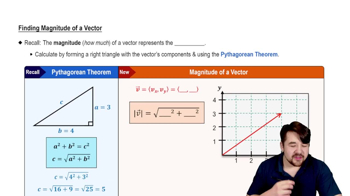
The magnitude or norm of a vector is the length of the vector in the coordinate plane. It is calculated using the distance formula derived from the Pythagorean theorem: ||v|| = √((x2 - x1)² + (y2 - y1)²), where (x1, y1) and (x2, y2) are the coordinates of the vector's initial and terminal points.
Recommended video:
04:44
Finding Magnitude of a Vector

Vector Direction and Scalar Multiples

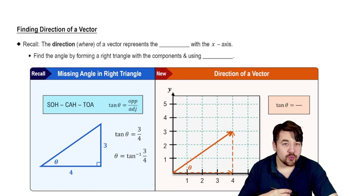
Two vectors have the same direction if one is a scalar multiple of the other. This means their components are proportional, and their direction angles are equal. Understanding this helps in finding one vector's magnitude when the other vector and their directional relationship are known.
Recommended video:
05:13
Finding Direction of a Vector

Coordinate Geometry of Vectors

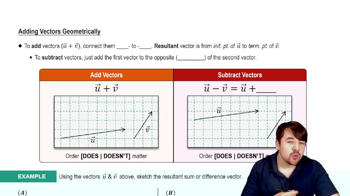
Vectors can be represented by coordinates in the Cartesian plane, with components derived from the difference between terminal and initial points. This representation allows for algebraic manipulation, such as finding magnitudes, directions, and verifying if vectors are parallel or have the same direction.
Recommended video:
05:29
Adding Vectors Geometrically