
Ch. 1 - Trigonometric Functions
Lial - Trigonometry 12th Edition
Lial12th EditionTrigonometryISBN: 9780136552161Not the one you use?Change textbook
Chapter 2, Problem 24

Find the six trigonometric function values for each angle. Rationalize denominators when applicable.

Verified step by step guidance
1
Identify the given angle and determine its position on the coordinate plane or its reference angle if not directly given. This will help in finding the sine, cosine, and tangent values.
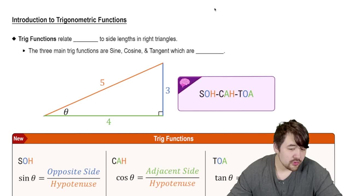
Recall the definitions of the six trigonometric functions in terms of a right triangle or the unit circle: \(\sin \theta = \frac{\text{opposite}}{\text{hypotenuse}}\), \(\cos \theta = \frac{\text{adjacent}}{\text{hypotenuse}}\), \(\tan \theta = \frac{\text{opposite}}{\text{adjacent}}\), \(\csc \theta = \frac{1}{\sin \theta}\), \(\sec \theta = \frac{1}{\cos \theta}\), \(\cot \theta = \frac{1}{\tan \theta}\).
Calculate the sine, cosine, and tangent values using the given angle or its reference triangle sides. If the problem provides side lengths, use those directly; if it provides an angle, use known values or the unit circle.
Find the cosecant, secant, and cotangent by taking the reciprocal of sine, cosine, and tangent respectively. Remember to rationalize denominators if any of these reciprocal values have radicals in the denominator.
Express all six trigonometric function values clearly, ensuring denominators are rationalized by multiplying numerator and denominator by the conjugate or appropriate radical to eliminate radicals from the denominator.

Verified video answer for a similar problem:

This video solution was recommended by our tutors as helpful for the problem above.
Video duration:
3m
Was this helpful?

Key Concepts

Here are the essential concepts you must grasp in order to answer the question correctly.

Six Trigonometric Functions

The six trigonometric functions are sine, cosine, tangent, cosecant, secant, and cotangent. They relate the angles of a right triangle to the ratios of its sides, and each function has a reciprocal counterpart (e.g., sine and cosecant). Understanding these functions is essential for finding their values for any given angle.
Recommended video:
6:04
Introduction to Trigonometric Functions

Rationalizing the Denominator

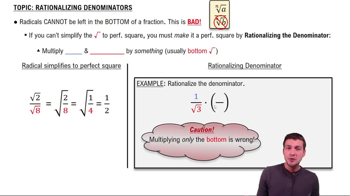
Rationalizing the denominator involves eliminating any square roots or irrational numbers from the denominator of a fraction. This is done by multiplying numerator and denominator by a suitable expression, making the expression simpler and more standardized, which is often required in trigonometric answers.
Recommended video:
2:58
Rationalizing Denominators

Evaluating Trigonometric Functions for Given Angles

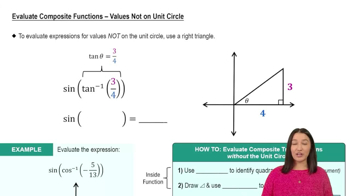
To find the values of trigonometric functions for specific angles, one can use the unit circle, special right triangles (30°-60°-90°, 45°-45°-90°), or trigonometric identities. This process involves substituting the angle into the function definitions and simplifying the results, often requiring knowledge of exact values.
Recommended video:
7:28
Evaluate Composite Functions - Values Not on Unit Circle