Ch. R - Algebra Review
Lial - Trigonometry 12th Edition
Lial12th EditionTrigonometryISBN: 9780136552161Not the one you use?Change textbook
Chapter 1, Problem 79

Graph each function. See Examples 6–8. g(x) = ½ x³ - 4

Verified step by step guidance
1
Identify the type of function given. Here, the function is a cubic function of the form \(g(x) = \frac{1}{2}x^{3} - 4\), which means it will have the general shape of a cubic curve but scaled and shifted.
Determine key features of the graph such as the y-intercept. To find the y-intercept, evaluate \(g(0)\): \(g(0) = \frac{1}{2} \times 0^{3} - 4\).
Find some additional points by choosing values for \(x\) (both positive and negative) and calculating the corresponding \(g(x)\) values. For example, calculate \(g(1)\), \(g(-1)\), \(g(2)\), and \(g(-2)\).
Plot the points found on the coordinate plane. This will help visualize the shape of the cubic function, noting that the coefficient \(\frac{1}{2}\) affects the steepness of the curve and the \(-4\) shifts the graph downward by 4 units.
Sketch the smooth curve passing through the plotted points, keeping in mind the typical cubic function shape: it decreases to the left, passes through the y-intercept, and increases to the right, with the curve flattened or stretched according to the coefficient.

Verified video answer for a similar problem:

This video solution was recommended by our tutors as helpful for the problem above.
Video duration:
5m
Was this helpful?

Key Concepts

Here are the essential concepts you must grasp in order to answer the question correctly.

Understanding Function Notation and Domain

Function notation, such as g(x), represents a rule that assigns each input x to an output value. Understanding the domain, which is the set of all possible x-values, is essential for graphing. For g(x) = ½ x³ - 4, the domain is all real numbers since any real x can be cubed and scaled.
Recommended video:
06:01
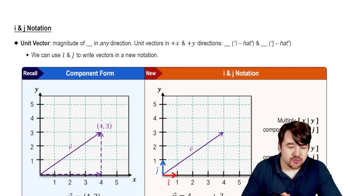
i & j Notation

Graphing Cubic Functions

Cubic functions have the general form ax³ + bx² + cx + d and produce characteristic S-shaped curves. The term ½ x³ indicates the function grows faster for large |x| values, while the constant -4 shifts the graph downward. Recognizing the shape and transformations helps in sketching the graph accurately.
Recommended video:
5:53
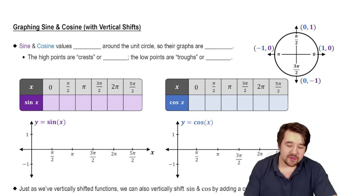
Graph of Sine and Cosine Function

Effect of Vertical Shifts on Graphs

Adding or subtracting a constant, like -4 in g(x) = ½ x³ - 4, shifts the entire graph vertically. This means every point on the cubic curve moves down by 4 units, affecting the y-intercept but not the shape. Understanding vertical shifts aids in correctly positioning the graph on the coordinate plane.
Recommended video:
6:31
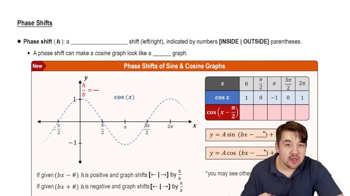
Phase Shifts