In Exercises 11–20, use a polar coordinate system like the one shown for Exercises 1–10 to plot each point with the given polar coordinates. (−2, − π/2)
Ch. 5 - Complex Numbers, Polar Coordinates and Parametric Equations

All textbooks
Blitzer 3rd Edition
Ch. 5 - Complex Numbers, Polar Coordinates and Parametric Equations
Problem 19
Blitzer 3rd Edition
Ch. 5 - Complex Numbers, Polar Coordinates and Parametric Equations
Problem 19Chapter 5, Problem 19
In Exercises 9–20, find each product and write the result in standard form. (2 + 3i)²
Verified step by step guidance1
Recall that to find the square of a complex number, such as \((2 + 3i)^2\), you can use the formula for the square of a binomial: \((a + b)^2 = a^2 + 2ab + b^2\).
Identify \(a = 2\) and \(b = 3i\) in the expression \((2 + 3i)^2\).
Apply the formula: calculate \(a^2 = (2)^2\), \(2ab = 2 \times 2 \times 3i\), and \(b^2 = (3i)^2\) separately.
Remember that \(i^2 = -1\), so when you calculate \(b^2 = (3i)^2\), rewrite it as \(3^2 \times i^2 = 9 \times (-1)\).
Combine all the terms: \(a^2 + 2ab + b^2\), simplify the real and imaginary parts separately to write the result in standard form \(x + yi\).

Verified video answer for a similar problem:
This video solution was recommended by our tutors as helpful for the problem above.
Video duration:
3mWas this helpful?
Key Concepts
Here are the essential concepts you must grasp in order to answer the question correctly.
Complex Numbers and Standard Form
Complex numbers are expressed in the form a + bi, where a is the real part and b is the imaginary part. The standard form means writing the result explicitly as a sum of a real number and an imaginary number multiplied by i.
Recommended video:
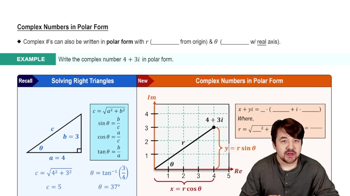
Complex Numbers In Polar Form
Binomial Expansion (Square of a Binomial)
Squaring a binomial (x + y)² involves expanding it as x² + 2xy + y². This method is essential for multiplying complex numbers like (2 + 3i)² by treating 2 and 3i as the terms x and y.
Recommended video:
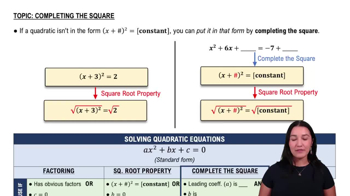
Solving Quadratic Equations by Completing the Square
Properties of the Imaginary Unit i
The imaginary unit i satisfies i² = -1. This property is crucial when simplifying powers of i during multiplication, converting terms like (3i)² into real numbers to write the final answer in standard form.
Recommended video:
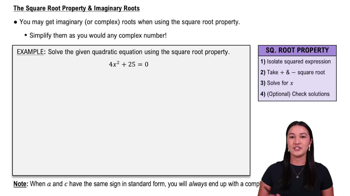
Imaginary Roots with the Square Root Property
Related Practice
Textbook Question
702
views
Textbook Question
In Exercises 11–26, plot each complex number. Then write the complex number in polar form. You may express the argument in degrees or radians. −3
434
views
Textbook Question
In Exercises 15–18, write each complex number in rectangular form. If necessary, round to the nearest tenth. 6 (cos 2π/3 + i sin 2π/3)
500
views
Textbook Question
In Exercises 19–21, find the product of the complex numbers. Leave answers in polar form.
z₁ = 3(cos 40°+i sin 40°)
z₂ = 5(cos 70°+i sin 70°)
526
views
Textbook Question
In Exercises 9–20, use point plotting to graph the plane curve described by the given parametric equations. Use arrows to show the orientation of the curve corresponding to increasing values of t. x = 2t, y = |t − 1|; −∞ < t < ∞
756
views
Textbook Question
In Exercises 13–34, test for symmetry and then graph each polar equation. r = 2 + cos θ
704
views