Simplify each expression. See Example 8. 10 - (4y + 8)
Verified step by step guidance
1
Identify the expression to simplify: \$10 - (4y + 8)$.
Apply the distributive property to remove the parentheses by multiplying the minus sign with each term inside: \$10 - 4y - 8$.
Combine like terms (constants) by subtracting 8 from 10: \((10 - 8) - 4y\).
Simplify the constants to get \$2 - 4y$.
Write the final simplified expression as \$2 - 4y$.
Verified video answer for a similar problem:
This video solution was recommended by our tutors as helpful for the problem above
Video duration:
1m
Play a video:
0 Comments
Key Concepts
Here are the essential concepts you must grasp in order to answer the question correctly.
Distributive Property
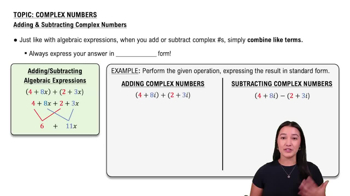
The distributive property allows you to multiply a single term across terms inside parentheses. For example, a(b + c) = ab + ac. In subtraction, it helps to remove parentheses by distributing the negative sign across the terms inside.
Combining like terms involves adding or subtracting terms that have the same variable raised to the same power. This simplifies expressions by reducing the number of terms, making it easier to work with or solve.
Simplifying expressions means rewriting them in a simpler or more compact form without changing their value. This often involves applying properties like distribution and combining like terms to make the expression easier to understand or solve.