Ch. 2 - Acute Angles and Right Triangles
Lial - Trigonometry 12th Edition
Lial12th EditionTrigonometryISBN: 9780136552161Not the one you use?Change textbook
Chapter 3, Problem 2.3.54

Use a calculator to determine whether each statement is true or false. A true statement may lead to results that differ in the last decimal place due to rounding error. cos 70° = 2 cos² 35° - 1

Verified step by step guidance
1
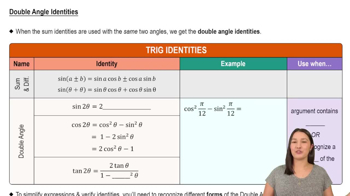
Recognize that the given equation resembles the double-angle identity for cosine, which states: \(\cos(2\theta) = 2\cos^{2}(\theta) - 1\).
Identify the angle \(\theta\) in the identity by comparing \(\cos 70^\circ\) with \(\cos(2\theta)\), so set \(2\theta = 70^\circ\) which gives \(\theta = 35^\circ\).
Rewrite the right side of the equation using the double-angle identity: \(2\cos^{2}(35^\circ) - 1\) should equal \(\cos(70^\circ)\) if the identity holds.
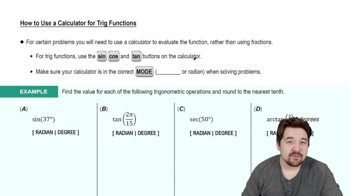
Use a calculator to find the numerical values of \(\cos 70^\circ\) and \(2\cos^{2} 35^\circ - 1\) separately, making sure your calculator is in degree mode.
Compare the two calculated values to determine if they are approximately equal, allowing for minor differences due to rounding errors, to conclude whether the statement is true or false.

Verified video answer for a similar problem:

This video solution was recommended by our tutors as helpful for the problem above.
Video duration:
2m
Was this helpful?

Key Concepts

Here are the essential concepts you must grasp in order to answer the question correctly.

Cosine Double-Angle Identity

The cosine double-angle identity states that cos(2θ) = 2cos²(θ) - 1. This formula allows expressing the cosine of a double angle in terms of the cosine of the original angle, which is essential for verifying the given equation involving cos 70° and cos 35°.
Recommended video:
05:06
Double Angle Identities

Use of Calculators and Rounding Errors

Calculators approximate trigonometric values, which can cause minor differences in the last decimal places due to rounding. Understanding this helps interpret results correctly when verifying trigonometric identities numerically.
Recommended video:
4:45
How to Use a Calculator for Trig Functions

Evaluating Trigonometric Expressions

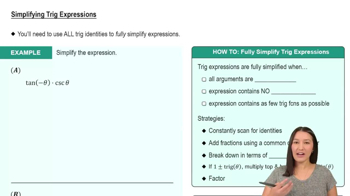
Evaluating trigonometric expressions involves substituting angle values and calculating the result accurately. This skill is necessary to compare both sides of the equation and determine if the statement is true or false.
Recommended video:
6:36
Simplifying Trig Expressions
Related Practice
Textbook Question

Find a value of θ in the interval [0°, 90°) that satisfies each statement. Give answers in decimal degrees to six decimal places. See Example 2. cot θ = 0.21563481

789
views

Textbook Question

Concept Check The two methods of expressing bearing can be interpreted using a rectangular coordinate system. Suppose that an observer for a radar station is located at the origin of a coordinate system. Find the bearing of an airplane located at each point. Express the bearing using both methods. (2, 2)

790
views
Textbook Question

Solve each problem. See Examples 1 and 2. Distance between Two Cities The bearing from Atlanta to Macon is S 27° E, and the bearing from Macon to Augusta is N 63° E. An automobile traveling at 62 mph needs 1¼ hr to go from Atlanta to Macon and 1¾ hr to go from Macon to Augusta. Find the distance from Atlanta to Augusta.

817
views
Textbook Question

(Modeling) Speed of Light When a light ray travels from one medium, such as air, to another medium, such as water or glass, the speed of the light changes, and the light ray is bent, or refracted, at the boundary between the two media. (This is why objects under water appear to be in a different position from where they really are.) It can be shown in physics that these changes are related by Snell's law c₁ = sin θ₁ , c₂ sin θ₂ where c₁ is the speed of light in the first medium, c₂ is the speed of light in the second medium, and θ₁ and θ₂ are the angles shown in the figure. In Exercises 81 and 82, assume that c₁ = 3 x 10⁸ m per sec. Find the speed of light in the second medium for each of the following. a. θ₁ = 46°, θ₂ = 31° b. θ₁ = 39°, θ₂ = 28°

589
views
Textbook Question

Use a calculator to approximate the value of each expression. Give answers to six decimal places. In Exercises 21–28, simplify the expression before using the calculator. See Example 1. csc 145° 45'

570
views
Textbook Question

Solve each problem. See Examples 1 and 2. Distance between Two Ships Two ships leave a port at the same time. The first ship sails on a bearing of 52° at 17 knots and the second on a bearing of 322° at 22 knots. How far apart are they after 2.5 hr?

986
views