Recognize that the expression inside the square root, \(\frac{1 + \cos\left(\frac{x}{4}\right)}{2}\), matches the form of the half-angle identity for cosine: \(\cos^2\left(\frac{\theta}{2}\right) = \frac{1 + \cos(\theta)}{2}\).
Identify \(\theta\) such that \(\theta = \frac{x}{2}\), so that \(\frac{\theta}{2} = \frac{x}{4}\). This means the expression inside the root is \(\cos^2\left(\frac{x}{4}\right)\).
Rewrite the square root expression as \(\pm \sqrt{\cos^2\left(\frac{x}{4}\right)}\).
Since the square root of a square is the absolute value, simplify to \(\pm \left| \cos\left(\frac{x}{4}\right) \right|\).
Finally, consider the \(\pm\) sign and the absolute value to write the simplified form as \(\pm \cos\left(\frac{x}{4}\right)\), noting that the sign depends on the context or domain of \(x\).
Verified video answer for a similar problem:
This video solution was recommended by our tutors as helpful for the problem above
Play a video:
0 Comments
Key Concepts
Here are the essential concepts you must grasp in order to answer the question correctly.
Half-Angle Identity for Cosine
The half-angle identity expresses the cosine of half an angle in terms of the cosine of the original angle: cos(θ/2) = ±√[(1 + cos θ)/2]. This formula helps simplify expressions involving cosines of fractional angles by rewriting them in a square root form.
Simplifying square root expressions involves recognizing perfect squares and applying algebraic manipulation to reduce the expression to its simplest form. Understanding when to apply the ± sign is crucial, as it depends on the angle's quadrant or domain.
The ± sign in trigonometric identities depends on the angle's quadrant, which determines the sign of the trigonometric function. Knowing the domain of x/4 helps decide whether the positive or negative root applies, ensuring the correct simplification.

 Verified step by step guidance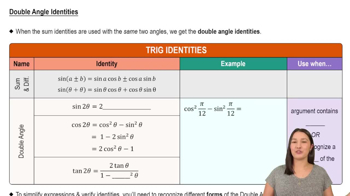
 05:06
05:06