Evaluate each expression without using a calculator.
tan (arccos 3/4)
Verified step by step guidance
1
Recognize that the expression is \( \tan(\arccos(\frac{3}{4})) \). Let \( \theta = \arccos(\frac{3}{4}) \), which means \( \cos \theta = \frac{3}{4} \) and \( \theta \) is an angle in the range \([0, \pi]\).
Use the Pythagorean identity to find \( \sin \theta \). Since \( \sin^2 \theta + \cos^2 \theta = 1 \), substitute \( \cos \theta = \frac{3}{4} \) to get \( \sin^2 \theta = 1 - \left(\frac{3}{4}\right)^2 \).
Calculate \( \sin \theta = \sqrt{1 - \left(\frac{3}{4}\right)^2} \). Since \( \theta \) is in the range \([0, \pi]\) and \( \arccos \) returns values in the first or second quadrant, \( \sin \theta \) is positive.
Recall that \( \tan \theta = \frac{\sin \theta}{\cos \theta} \). Substitute the values of \( \sin \theta \) and \( \cos \theta \) to express \( \tan(\arccos(\frac{3}{4})) \) as a fraction.
Simplify the fraction to get the exact value of \( \tan(\arccos(\frac{3}{4})) \) without using a calculator.
Verified video answer for a similar problem:
This video solution was recommended by our tutors as helpful for the problem above
Play a video:
0 Comments
Key Concepts
Here are the essential concepts you must grasp in order to answer the question correctly.
Inverse Trigonometric Functions
Inverse trigonometric functions, like arccos, return the angle whose trigonometric ratio is given. For example, arccos(3/4) gives the angle whose cosine is 3/4. Understanding this allows you to translate the problem into finding trigonometric values of specific angles.
Using the value of cosine as the ratio of adjacent side over hypotenuse, you can construct a right triangle to find the other sides. This helps in determining sine and tangent values by applying the Pythagorean theorem to find the missing side lengths.
Tangent of an angle is defined as the ratio of sine to cosine (tan θ = sin θ / cos θ). Once sine and cosine values are known or derived, you can compute tangent without a calculator by simple fraction operations.

 Verified step by step guidance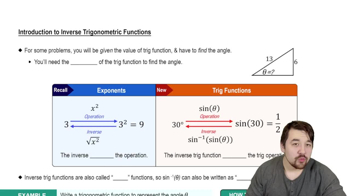
 4:28
4:28