Ch. R - Algebra Review
Lial - Trigonometry 12th Edition
Lial12th EditionTrigonometryISBN: 9780136552161Not the one you use?Change textbook
Chapter 1, Problem 13

Find the domain of each rational expression. See Example 1. (3x + 7) / (4x + 2) (x - 1)

Verified step by step guidance
1
Identify the rational expression given: \(\frac{3x + 7}{(4x + 2)(x - 1)}\).
Recall that the domain of a rational expression excludes values of \(x\) that make the denominator equal to zero, because division by zero is undefined.
Set each factor in the denominator equal to zero to find the excluded values: solve \(4x + 2 = 0\) and \(x - 1 = 0\) separately.
Solve \(4x + 2 = 0\) by isolating \(x\): \(4x = -2\) then \(x = -\frac{1}{2}\); solve \(x - 1 = 0\) to get \(x = 1\).
Conclude that the domain is all real numbers except \(x = -\frac{1}{2}\) and \(x = 1\), since these values make the denominator zero.

Verified video answer for a similar problem:

This video solution was recommended by our tutors as helpful for the problem above.
Video duration:
4m
Was this helpful?

Key Concepts

Here are the essential concepts you must grasp in order to answer the question correctly.

Domain of a Rational Expression

The domain of a rational expression includes all real numbers except those that make the denominator zero. Since division by zero is undefined, identifying values that cause the denominator to be zero is essential to determine the domain.
Recommended video:
2:58
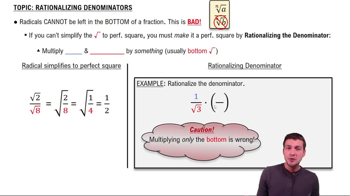
Rationalizing Denominators

Factoring and Setting Denominator Equal to Zero

To find values excluded from the domain, factor the denominator if possible and set each factor equal to zero. Solving these equations reveals the values that make the denominator zero, which must be excluded from the domain.
Recommended video:
3:42
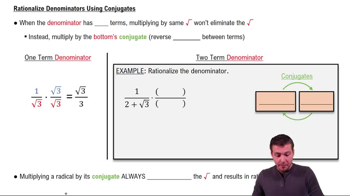
Rationalizing Denominators Using Conjugates

Simplifying Rational Expressions

Simplifying the rational expression by canceling common factors can help in understanding the expression better, but it does not change the domain. The original restrictions from the denominator remain, regardless of simplification.
Recommended video:
2:58
Rationalizing Denominators