Ch. R - Algebra Review
Lial - Trigonometry 12th Edition
Lial12th EditionTrigonometryISBN: 9780136552161Not the one you use?Change textbook
Chapter 1, Problem 55

Evaluate each expression. See Example 5. |3⁄2|

Verified step by step guidance
1
Recognize that the expression involves the absolute value function, denoted by vertical bars \(| \cdot |\), which returns the non-negative value of the number inside.
Identify the number inside the absolute value: \(\frac{3}{2}\).
Recall that the absolute value of a positive number is the number itself, so \(| \frac{3}{2} | = \frac{3}{2}\).
Express the final answer as a positive fraction or decimal, depending on the context of the problem.
No further simplification is needed since \(\frac{3}{2}\) is already in simplest form.

Verified video answer for a similar problem:

This video solution was recommended by our tutors as helpful for the problem above.
Video duration:
1m
Was this helpful?

Key Concepts

Here are the essential concepts you must grasp in order to answer the question correctly.

Absolute Value

The absolute value of a number represents its distance from zero on the number line, regardless of direction. It is always non-negative. For example, |3/2| equals 3/2 because 3/2 is positive, while |-3/2| would also equal 3/2.
Recommended video:
7:28
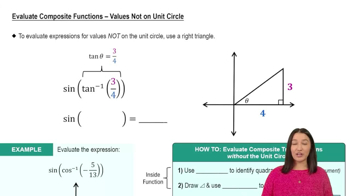
Evaluate Composite Functions - Values Not on Unit Circle

Fractional Numbers

Fractions represent parts of a whole and are expressed as a ratio of two integers, numerator over denominator. Understanding how to interpret and manipulate fractions is essential when evaluating expressions involving fractional values.
Recommended video:
4:02
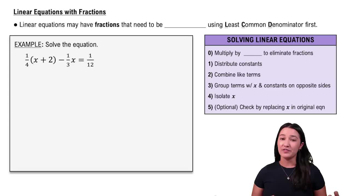
Solving Linear Equations with Fractions

Evaluating Expressions

Evaluating an expression means simplifying it to a single value by applying mathematical operations and rules. In this case, it involves applying the absolute value operation to the given fraction to find its magnitude.
Recommended video:
3:48
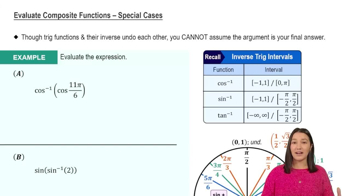
Evaluate Composite Functions - Special Cases