In Exercises 32–35, find all the complex roots. Write roots in rectangular form.The complex fifth roots of −1 − i
Verified step by step guidance
1
Express the complex number \(-1 - i\) in polar form. To do this, find the magnitude \(r\) using \(r = \sqrt{(-1)^2 + (-1)^2}\) and the angle \(\theta\) using \(\theta = \tan^{-1}\left(\frac{-1}{-1}\right)\).
Convert the angle \(\theta\) to the correct quadrant since \(-1 - i\) is in the third quadrant. Adjust \(\theta\) by adding \(\pi\) to the principal value if necessary.
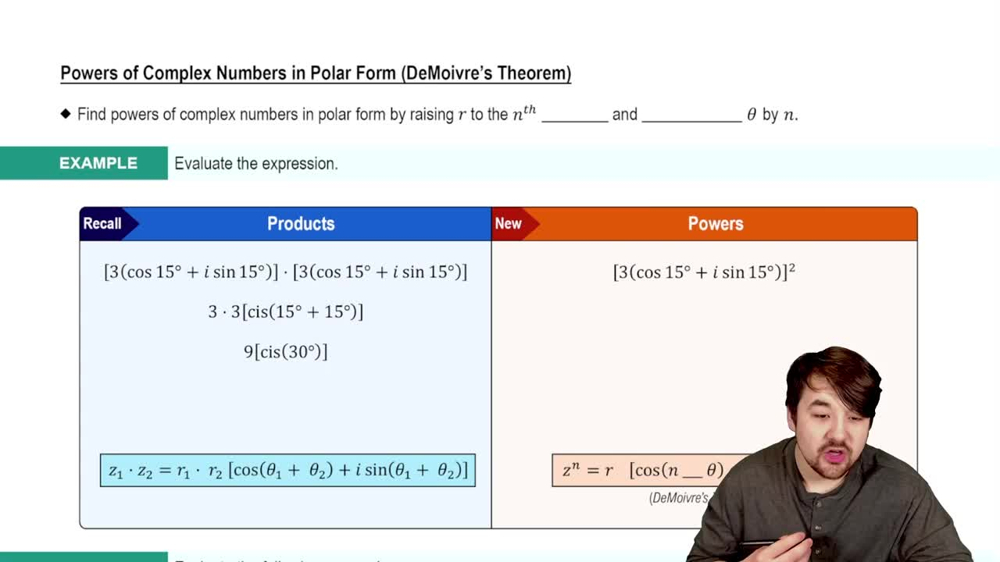
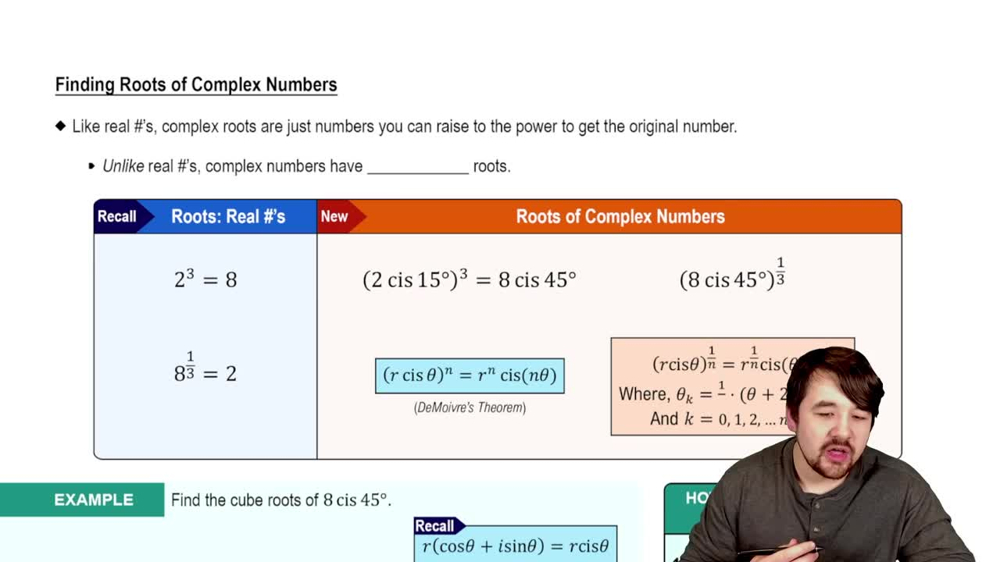
Use De Moivre's Theorem to find the fifth roots. The formula is \(z_k = r^{1/5} \left( \cos\left(\frac{\theta + 2k\pi}{5}\right) + i\sin\left(\frac{\theta + 2k\pi}{5}\right) \right)\) for \(k = 0, 1, 2, 3, 4\).
Calculate each root by substituting \(k = 0, 1, 2, 3, 4\) into the formula. This will give you the five distinct complex roots.
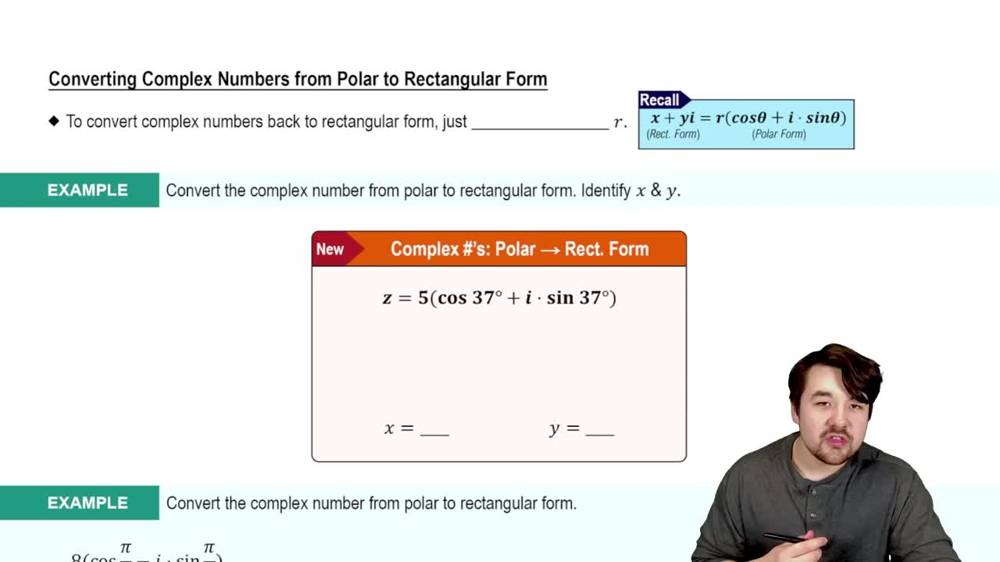
Express each root in rectangular form by evaluating the cosine and sine components for each \(k\) and simplifying the expression.
Verified video answer for a similar problem:
This video solution was recommended by our tutors as helpful for the problem above
Play a video:
0 Comments
Key Concepts
Here are the essential concepts you must grasp in order to answer the question correctly.
Complex Numbers
Complex numbers are numbers that have a real part and an imaginary part, expressed in the form a + bi, where 'a' is the real part and 'b' is the imaginary part. In this context, -1 - i is a complex number where -1 is the real part and -1 is the coefficient of the imaginary unit 'i'. Understanding how to manipulate and represent complex numbers is essential for finding their roots.
The polar form of a complex number expresses it in terms of its magnitude (r) and angle (θ) with respect to the positive real axis, represented as r(cos θ + i sin θ) or re^(iθ). This form is particularly useful for finding roots, as it simplifies the process of applying De Moivre's Theorem, which states that the nth roots of a complex number can be found by dividing the angle by n and taking the nth root of the magnitude.
De Moivre's Theorem provides a method for raising complex numbers in polar form to a power or extracting roots. It states that for a complex number in polar form r(cos θ + i sin θ), the nth roots can be calculated as r^(1/n)(cos(θ/n + 2kπ/n) + i sin(θ/n + 2kπ/n)), where k is an integer from 0 to n-1. This theorem is crucial for determining the complex fifth roots of -1 - i.