Write each trigonometric expression as an algebraic expression in u, for u > 0. sin (arccos u)
Verified step by step guidance
1
Recognize that the expression is \( \sin(\arccos u) \). Let \( \theta = \arccos u \), which means \( \cos \theta = u \) and \( \theta \) is an angle whose cosine is \( u \).
Since \( \theta = \arccos u \), \( \theta \) lies in the range \( [0, \pi] \), and given \( u > 0 \), \( \theta \) is in the first quadrant where sine is positive.
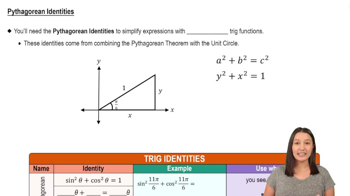
Use the Pythagorean identity for sine and cosine: \( \sin^2 \theta + \cos^2 \theta = 1 \). Substitute \( \cos \theta = u \) to get \( \sin^2 \theta = 1 - u^2 \).
Take the positive square root (since \( \theta \) is in the first quadrant) to find \( \sin \theta = \sqrt{1 - u^2} \).
Therefore, \( \sin(\arccos u) = \sqrt{1 - u^2} \), which expresses the original trigonometric expression algebraically in terms of \( u \).
Verified video answer for a similar problem:
This video solution was recommended by our tutors as helpful for the problem above
Play a video:
0 Comments
Key Concepts
Here are the essential concepts you must grasp in order to answer the question correctly.
Inverse Trigonometric Functions
Inverse trigonometric functions, like arccos, return an angle whose trigonometric function equals the given value. For arccos u, it gives an angle θ such that cos θ = u, with θ in the range [0, π]. Understanding this helps convert expressions involving inverse functions into angle-based forms.
The Pythagorean identity states that sin²θ + cos²θ = 1 for any angle θ. This relationship allows us to express sin θ in terms of cos θ as sin θ = √(1 - cos²θ), which is essential when rewriting sin(arccos u) as an algebraic expression in u.
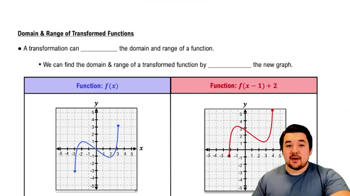
When dealing with inverse trig functions and their compositions, it's important to consider the domain and range to determine the correct sign of the resulting expression. Since u > 0 and arccos u ∈ [0, π/2), sin(arccos u) is positive, ensuring the positive root is chosen in the algebraic expression.

 Verified step by step guidance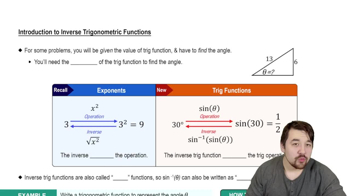
 4:28
4:28