Ch. 4 - Laws of Sines and Cosines; Vectors
Blitzer - Trigonometry 3rd Edition
Blitzer3rd EditionTrigonometryISBN: 9780137316601Not the one you use?Change textbook
Chapter 4, Problem 44

In Exercises 43–44, use the given measurements to solve the following triangle. Round lengths of sides to the nearest tenth and angle measures to the nearest degree. a = 400, b = 300

Verified step by step guidance
1
Identify the given elements of the triangle: side \(a = 400\) and side \(b = 300\). Since no angles are given, determine if the triangle is right-angled or if additional information is needed to solve it completely.
If the triangle is right-angled, use the Pythagorean theorem to find the third side \(c\): \(c = \sqrt{a^2 + b^2}\). If not, check if an angle is provided or if you can use the Law of Cosines or Law of Sines.
Assuming you have an angle opposite one of the given sides, use the Law of Sines: \(\frac{a}{\sin A} = \frac{b}{\sin B} = \frac{c}{\sin C}\). Rearrange to find the unknown angles.
If no angles are given, and you have two sides, use the Law of Cosines to find the angle between them: \(c^2 = a^2 + b^2 - 2ab \cos C\). Solve for \(\cos C\) and then find angle \(C\).
Once all sides and angles are found, round the side lengths to the nearest tenth and the angle measures to the nearest degree as required.

Verified video answer for a similar problem:

This video solution was recommended by our tutors as helpful for the problem above.
Video duration:
7m
Was this helpful?

Key Concepts

Here are the essential concepts you must grasp in order to answer the question correctly.

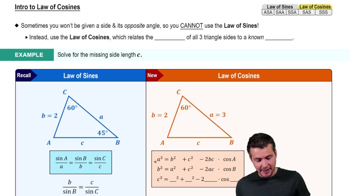
Law of Cosines

The Law of Cosines relates the lengths of the sides of a triangle to the cosine of one of its angles. It is especially useful for solving triangles when two sides and the included angle or three sides are known. The formula is c² = a² + b² - 2ab cos(C), allowing calculation of unknown sides or angles.
Recommended video:
4:35
Intro to Law of Cosines

Triangle Angle Sum Property

The sum of the interior angles in any triangle is always 180 degrees. After finding one or two angles using trigonometric laws, this property helps determine the remaining angle by subtracting the known angles from 180°.
Recommended video:
4:47
Sum and Difference of Tangent

Rounding and Approximation in Trigonometry

When solving triangles, side lengths and angle measures often result in decimal values. Rounding to the nearest tenth for sides and nearest degree for angles ensures practical and clear answers, balancing precision with usability in real-world contexts.
Recommended video:
5:32
Fundamental Trigonometric Identities