3. Unit Circle
Reference Angles

 3:38 minutes
Problem 1.55
Textbook Question
Find the reference angle for each angle.
23π/4
 Verified step by step guidance
1
Convert the given angle from radians to degrees by multiplying \( \frac{23\pi}{4} \) by \( \frac{180}{\pi} \).
Simplify the expression to find the angle in degrees.
Determine how many full rotations (360 degrees) are contained within the angle by dividing the angle in degrees by 360.
Subtract the number of full rotations (in degrees) from the original angle to find the equivalent angle between 0 and 360 degrees.
If the resulting angle is greater than 180 degrees, subtract it from 360 degrees to find the reference angle. Otherwise, the resulting angle is the reference angle.
Recommended similar problem, with video answer:
Verified SolutionThis video solution was recommended by our tutors as helpful for the problem above

Video duration:
3mWas this helpful?
Key Concepts
Here are the essential concepts you must grasp in order to answer the question correctly.
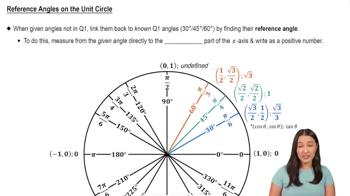
Reference Angle
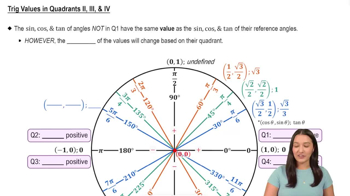
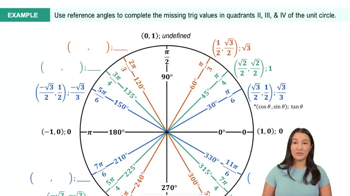
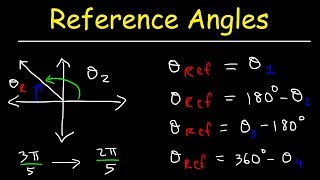
The reference angle is the acute angle formed by the terminal side of a given angle and the x-axis. It is always measured as a positive angle and is typically between 0 and π/2 radians. For angles greater than 2π, the reference angle helps simplify trigonometric calculations by relating the angle to its equivalent acute angle.
Recommended video:
 5:31
5:31
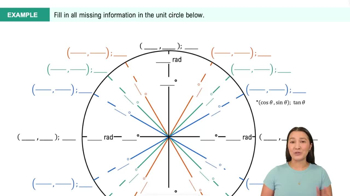
Reference Angles on the Unit Circle
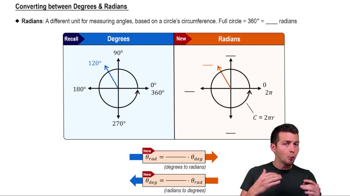
Angle Measurement in Radians
Angles can be measured in degrees or radians, with radians being the standard unit in trigonometry. One full rotation (360 degrees) is equivalent to 2π radians. Understanding how to convert between these two units is essential for finding reference angles, especially when dealing with angles larger than 2π.
Recommended video:
 5:04
5:04Converting between Degrees & Radians
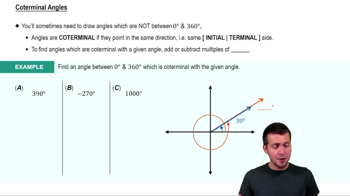
Finding Coterminal Angles
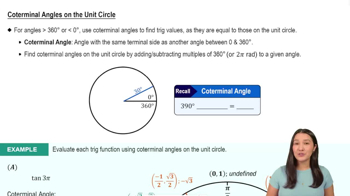
Coterminal angles are angles that share the same terminal side when drawn in standard position. To find a coterminal angle, you can add or subtract multiples of 2π. This concept is crucial for determining the reference angle, as it allows you to reduce larger angles to their equivalent angles within the standard range of 0 to 2π.
Recommended video:
 3:47
3:47Coterminal Angles
5:31mWatch next
Master Reference Angles on the Unit Circle with a bite sized video explanation from Callie Rethman
Start learningRelated Videos
Related Practice