Ch. 1 - Trigonometric Functions
Lial - Trigonometry 12th Edition
Lial12th EditionTrigonometryISBN: 9780136552161Not the one you use?Change textbook
Chapter 2, Problem 46

Perform each calculation. See Example 3. 90° ― 17° 13'

Verified step by step guidance
1
Understand that the problem requires subtracting two angles: 90° and 17° 13'. The first angle is in degrees only, and the second angle is in degrees and minutes.
Recall that 1 degree (°) equals 60 minutes ('). To perform the subtraction, convert the angles into a consistent format if necessary, or subtract degrees and minutes separately.
Since 90° has 0 minutes, and 17° 13' has 13 minutes, check if you can subtract 13 minutes from 0 minutes directly. If not, borrow 1 degree from 90°, converting it into 60 minutes.
After borrowing, subtract the minutes: (60' - 13') and subtract the degrees: (89° - 17°). Write the result as degrees and minutes.
Combine the results to express the final answer in degrees and minutes format.

Verified video answer for a similar problem:

This video solution was recommended by our tutors as helpful for the problem above.
Video duration:
2m
Was this helpful?

Key Concepts

Here are the essential concepts you must grasp in order to answer the question correctly.

Angle Measurement in Degrees, Minutes, and Seconds

Angles can be expressed in degrees (°), minutes ('), and seconds ("), where 1 degree equals 60 minutes and 1 minute equals 60 seconds. Understanding this notation is essential for performing accurate calculations involving angles.
Recommended video:
5:31
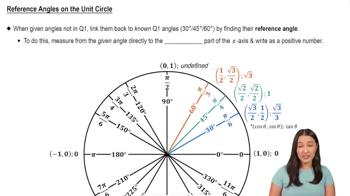
Reference Angles on the Unit Circle

Subtraction of Angles in DMS Format

When subtracting angles given in degrees, minutes, and seconds (DMS), you must subtract each unit separately, borrowing from higher units if necessary (e.g., borrowing 1 degree as 60 minutes) to handle cases where the minuend's minutes or seconds are smaller than the subtrahend's.
Recommended video:
3:18
Adding and Subtracting Complex Numbers

Conversion Between Units for Simplification

To simplify calculations, angles in DMS format can be converted entirely into decimal degrees or into total seconds before performing arithmetic, then converted back to DMS. This method helps avoid errors in borrowing and makes calculations more straightforward.
Recommended video:
06:11
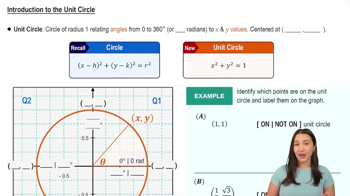
Introduction to the Unit Circle