Consider each case and determine whether there is sufficient information to solve the triangle using the law of sines.
Three sides are known.
Verified step by step guidance
1
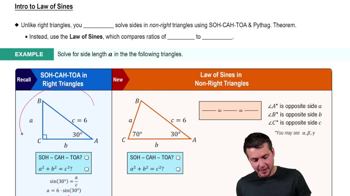
Recall that the Law of Sines states: \(\frac{a}{\sin A} = \frac{b}{\sin B} = \frac{c}{\sin C}\), where \(a\), \(b\), and \(c\) are the sides opposite angles \(A\), \(B\), and \(C\) respectively.
When three sides of a triangle are known (SSS case), the Law of Sines alone is not sufficient to solve the triangle because it relates sides to angles but does not directly provide an angle without at least one angle known.
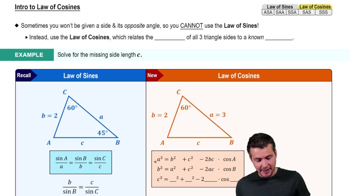
Instead, use the Law of Cosines to find one angle first. The Law of Cosines formula is: \(c^2 = a^2 + b^2 - 2ab \cos C\) (and similarly for other angles).
After finding one angle using the Law of Cosines, you can then apply the Law of Sines to find the remaining angles and sides if needed.
Therefore, with three sides known, the Law of Sines alone is not sufficient; you must start with the Law of Cosines to solve the triangle.
Verified video answer for a similar problem:
This video solution was recommended by our tutors as helpful for the problem above
Play a video:
0 Comments
Key Concepts
Here are the essential concepts you must grasp in order to answer the question correctly.
Law of Sines
The Law of Sines relates the ratios of the lengths of sides of a triangle to the sines of their opposite angles. It is expressed as (a/sin A) = (b/sin B) = (c/sin C). This law is useful for solving triangles when given certain combinations of sides and angles, but it requires at least one angle-side opposite pair.
To solve a triangle, sufficient information about sides and angles must be known. The Law of Sines is applicable when at least one angle and its opposite side are known. Knowing only three sides (SSS) does not provide an angle-side pair, so the Law of Sines alone cannot solve the triangle in this case.
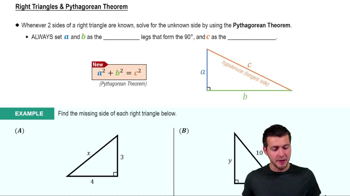
Solving Right Triangles with the Pythagorean Theorem
Law of Cosines
The Law of Cosines is used to solve triangles when three sides are known (SSS) or two sides and the included angle (SAS). It relates the lengths of sides to the cosine of an angle, allowing calculation of angles from side lengths. For three known sides, the Law of Cosines is the appropriate method, not the Law of Sines.