Solve each equation for exact solutions. sin⁻¹ x - 4 tan⁻¹ (-1) = 2π
Verified step by step guidance
1
Recognize that the equation is given as \(\sin^{-1} x - 4 \tan^{-1}(-1) = 2\pi\). Our goal is to solve for \(x\) in terms of exact values.
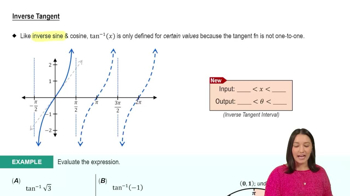
Evaluate the inverse tangent term \(\tan^{-1}(-1)\). Recall that \(\tan^{-1}(-1)\) is the angle whose tangent is \(-1\). Identify this angle within the principal range of \(\tan^{-1}\), which is \(\left(-\frac{\pi}{2}, \frac{\pi}{2}\right)\).
Multiply the value of \(\tan^{-1}(-1)\) by 4, as indicated by the equation, to simplify the expression \(-4 \tan^{-1}(-1)\).
Rewrite the equation as \(\sin^{-1} x = 2\pi + 4 \tan^{-1}(-1)\), substituting the evaluated value from the previous step. This isolates \(\sin^{-1} x\) on one side.
Use the definition of \(\sin^{-1} x\) (the inverse sine function) to solve for \(x\). Recall that if \(\sin^{-1} x = \theta\), then \(x = \sin \theta\). Substitute the angle found in the previous step to express \(x\) exactly.
Verified video answer for a similar problem:
This video solution was recommended by our tutors as helpful for the problem above
Play a video:
0 Comments
Key Concepts
Here are the essential concepts you must grasp in order to answer the question correctly.
Inverse Trigonometric Functions
Inverse trigonometric functions, such as sin⁻¹(x) and tan⁻¹(x), return the angle whose sine or tangent is x. They are essential for solving equations where the variable is inside a trigonometric function, allowing us to isolate and find angle values.
The value of tan⁻¹(-1) corresponds to an angle whose tangent is -1, typically -π/4 in the principal range (-π/2, π/2). Understanding how to evaluate inverse tangent for negative inputs is crucial for simplifying and solving the given equation.
Solving Trigonometric Equations with Multiple Terms
When solving equations involving sums or differences of inverse trig functions, isolate the unknown term and use known values or identities to simplify. Recognizing how to manipulate and combine these terms helps find exact solutions within the correct domain.

 Verified step by step guidance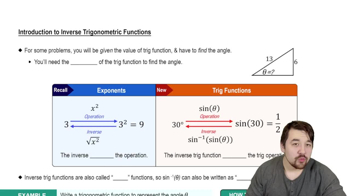
 4:28
4:28