Ch. 1 - Angles and the Trigonometric Functions
Blitzer - Trigonometry 3rd Edition
Blitzer3rd EditionTrigonometryISBN: 9780137316601Not the one you use?Change textbook
Chapter 1, Problem 85

Use reference angles to find the exact value of each expression. Do not use a calculator. sin (-17πœ‹/3)

Verified step by step guidance
1
First, recognize that the angle given is in radians and is negative: \(-\frac{17\pi}{3}\). To work with this angle, we want to find a coterminal angle between \(0\) and \(2\pi\) by adding multiples of \(2\pi\) until the angle is positive and within one full rotation.
Since one full rotation is \(2\pi = \frac{6\pi}{3}\), add \(2\pi\) repeatedly to \(-\frac{17\pi}{3}\) until the angle is between \(0\) and \(2\pi\). Calculate \(-\frac{17\pi}{3} + n \times \frac{6\pi}{3}\) for some integer \(n\).
Once you find the positive coterminal angle \(\theta\), determine its reference angle. The reference angle is the acute angle between \(\theta\) and the nearest x-axis (either \(0\), \(\pi\), or \(2\pi\)).
Identify the quadrant in which the coterminal angle lies. This is important because the sign of \(\sin(\theta)\) depends on the quadrant: positive in Quadrants I and II, negative in Quadrants III and IV.
Use the reference angle to find the exact value of \(\sin(\theta)\) using known sine values of special angles (like \(\frac{\pi}{6}\), \(\frac{\pi}{4}\), \(\frac{\pi}{3}\), etc.), and apply the appropriate sign based on the quadrant.

Verified video answer for a similar problem:

This video solution was recommended by our tutors as helpful for the problem above.
Video duration:
4m
Was this helpful?

Key Concepts

Here are the essential concepts you must grasp in order to answer the question correctly.

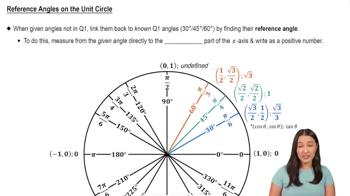
Reference Angles

A reference angle is the acute angle formed between the terminal side of an angle and the x-axis. It helps simplify trigonometric calculations by relating any angle to a corresponding angle in the first quadrant, where trigonometric values are well-known.
Recommended video:
5:31
Reference Angles on the Unit Circle

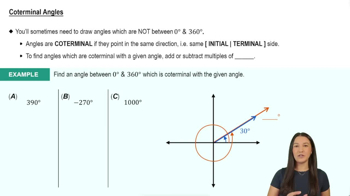
Angle Coterminality and Reduction

Angles that differ by full rotations (multiples of 2Ο€ radians) share the same terminal side and thus have the same trigonometric values. Reducing an angle by adding or subtracting 2Ο€ simplifies the angle to an equivalent one within a standard interval, making calculations easier.
Recommended video:
04:46
Coterminal Angles

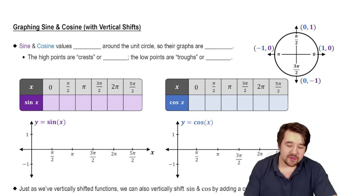
Sine Function Properties and Sign Determination

The sine function is periodic with period 2Ο€ and odd, meaning sin(-ΞΈ) = -sin(ΞΈ). The sign of sine depends on the quadrant of the angle: positive in the first and second quadrants, negative in the third and fourth. This helps determine the exact value after finding the reference angle.
Recommended video:
5:53
Graph of Sine and Cosine Function