Ch. 1 - Angles and the Trigonometric Functions
Blitzer - Trigonometry 3rd Edition
Blitzer3rd EditionTrigonometryISBN: 9780137316601Not the one you use?Change textbook
Chapter 1, Problem 41

In Exercises 41–56, use the circle shown in the rectangular coordinate system to draw each angle in standard position. State the quadrant in which the angle lies. When an angle's measure is given in radians, work the exercise without converting to degrees.
Circle in rectangular coordinates for measuring angles in standard position.
7πœ‹/6

Verified step by step guidance
1
Understand that the angle is given in radians as \(\frac{7\pi}{6}\), which means the angle is measured counterclockwise from the positive x-axis.
Recall that \(\pi\) radians corresponds to 180 degrees, so \(\frac{7\pi}{6}\) is slightly more than \(\pi\) (180 degrees), specifically \(\pi + \frac{\pi}{6}\).
Since \(\pi\) radians points directly to the negative x-axis, adding \(\frac{\pi}{6}\) radians (30 degrees) moves the terminal side of the angle into the third quadrant.
Draw the angle starting from the positive x-axis, rotating counterclockwise past \(\pi\) radians, and stopping at \(\frac{7\pi}{6}\) radians, which lies in the third quadrant.
State that the angle \(\frac{7\pi}{6}\) lies in the third quadrant.

Verified video answer for a similar problem:

This video solution was recommended by our tutors as helpful for the problem above.
Video duration:
2m
Was this helpful?

Key Concepts

Here are the essential concepts you must grasp in order to answer the question correctly.

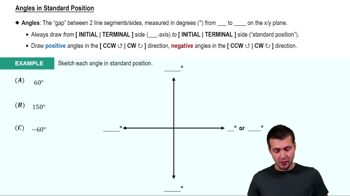
Angles in Standard Position

An angle is in standard position when its vertex is at the origin of the coordinate system and its initial side lies along the positive x-axis. The terminal side is determined by rotating the initial side counterclockwise for positive angles and clockwise for negative angles.
Recommended video:
05:50
Drawing Angles in Standard Position

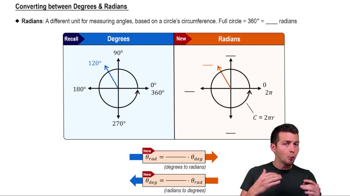
Radian Measure of Angles

Radians measure angles based on the radius of a circle. One full rotation around a circle is 2Ο€ radians. Angles can be expressed as multiples or fractions of Ο€, which allows direct use in trigonometric functions without converting to degrees.
Recommended video:
5:04
Converting between Degrees & Radians

Quadrants in the Coordinate Plane

The coordinate plane is divided into four quadrants by the x- and y-axes. The quadrant in which an angle's terminal side lies depends on the angle's measure. For example, an angle between Ο€ and 3Ο€/2 radians lies in the third quadrant.
Recommended video:
6:36
Quadratic Formula