In Exercises 21–28, an object moves in simple harmonic motion described by the given equation, where t is measured in seconds and d in inches. In each exercise, find the following: a. the maximum displacement b. the frequency c. the time required for one cycle. d = −4 sin 3π/2 t
Ch. 2 - Graphs of the Trigonometric Functions; Inverse Trigonometric Functions

All textbooks
Blitzer 3rd Edition
Ch. 2 - Graphs of the Trigonometric Functions; Inverse Trigonometric Functions
Problem 29
Blitzer 3rd Edition
Ch. 2 - Graphs of the Trigonometric Functions; Inverse Trigonometric Functions
Problem 29Chapter 2, Problem 29
In Exercises 27–38, use a calculator to find the value of each expression rounded to two decimal places. sin⁻¹ (-0.32)
Verified step by step guidance1
Identify the function involved: here, \( \sin^{-1} \) represents the inverse sine function, also known as arcsine, which gives the angle whose sine is the given value.
Recall the domain and range of the inverse sine function: the input value must be between -1 and 1, and the output angle will be in the range \( [-\frac{\pi}{2}, \frac{\pi}{2}] \) or equivalently \( [-90^\circ, 90^\circ] \). Since -0.32 is within the domain, the calculation is valid.
Use a calculator set to the correct mode (degrees or radians depending on the problem context) to find \( \sin^{-1}(-0.32) \).
Input the value -0.32 into the inverse sine function on the calculator to get the angle whose sine is -0.32.
Round the resulting angle to two decimal places as required.

Verified video answer for a similar problem:
This video solution was recommended by our tutors as helpful for the problem above.
Video duration:
1mWas this helpful?
Key Concepts
Here are the essential concepts you must grasp in order to answer the question correctly.
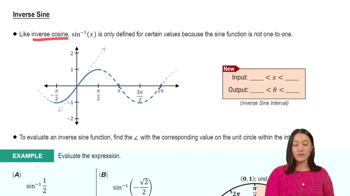
Inverse Sine Function (sin⁻¹ or arcsin)
The inverse sine function, denoted as sin⁻¹ or arcsin, returns the angle whose sine is a given number. It is defined for inputs between -1 and 1 and outputs angles typically in the range of -90° to 90° (or -π/2 to π/2 radians). Understanding this helps in finding the angle corresponding to a sine value.
Recommended video:
Inverse Sine
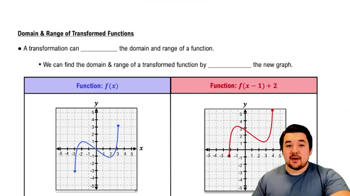
Domain and Range of the Inverse Sine Function
The domain of sin⁻¹ is limited to values between -1 and 1 because sine values cannot exceed this range. The range of sin⁻¹ is the set of possible output angles, usually from -90° to 90°. Recognizing these limits ensures the input is valid and the output angle is interpreted correctly.
Recommended video:
Domain and Range of Function Transformations
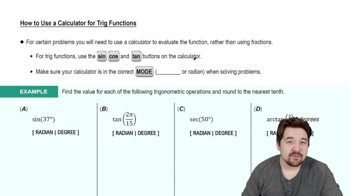
Using a Calculator to Evaluate Inverse Trigonometric Functions
Calculators have specific modes (degree or radian) that affect the output of inverse trig functions. To find sin⁻¹(-0.32), input the value correctly and ensure the calculator is set to the desired angle unit. Rounding the result to two decimal places provides a precise and usable answer.
Recommended video:
How to Use a Calculator for Trig Functions
Related Practice
Textbook Question
1160
views
Textbook Question
Graph two periods of the given cosecant or secant function.
y = 2 csc x
865
views
Textbook Question
In Exercises 29–44, graph two periods of the given cosecant or secant function. y = 3 csc x
1018
views
Textbook Question
In Exercises 17–30, determine the amplitude, period, and phase shift of each function. Then graph one period of the function. y = −2 sin(2πx + 4π)
561
views
Textbook Question
Use each graph to obtain the graph of the corresponding reciprocal function, cosecant or secant. Give the equation of the function for the graph that you obtain.
<IMAGE>
485
views
Textbook Question
In Exercises 29–36, find the length x to the nearest whole unit.
462
views