Ch. R - Algebra Review
Lial - Trigonometry 12th Edition
Lial12th EditionTrigonometryISBN: 9780136552161Not the one you use?Change textbook
Chapter 1, Problem 129

Rationalize each denominator. See Example 8. 6/(√5 + √3)

Verified step by step guidance
1
Identify the expression to rationalize: \(\frac{6}{\sqrt{5} + \sqrt{3}}\).
Recall that to rationalize a denominator with two terms involving square roots, multiply numerator and denominator by the conjugate of the denominator. The conjugate of \(\sqrt{5} + \sqrt{3}\) is \(\sqrt{5} - \sqrt{3}\).
Multiply both numerator and denominator by the conjugate: \(\frac{6}{\sqrt{5} + \sqrt{3}} \times \frac{\sqrt{5} - \sqrt{3}}{\sqrt{5} - \sqrt{3}}\).
Use the difference of squares formula for the denominator: \((a + b)(a - b) = a^2 - b^2\). Here, \(a = \sqrt{5}\) and \(b = \sqrt{3}\), so the denominator becomes \$5 - 3$.
Simplify the numerator by distributing 6: \(6(\sqrt{5} - \sqrt{3})\), and simplify the denominator to \(2\). The expression is now rationalized.

Verified video answer for a similar problem:

This video solution was recommended by our tutors as helpful for the problem above.
Video duration:
3m
Was this helpful?

Key Concepts

Here are the essential concepts you must grasp in order to answer the question correctly.

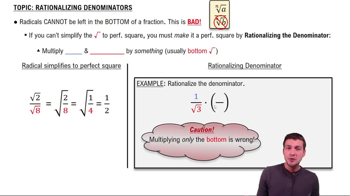
Rationalizing the Denominator

Rationalizing the denominator involves eliminating any square roots or irrational numbers from the denominator of a fraction. This is done to simplify the expression and make it easier to work with, often by multiplying numerator and denominator by a conjugate or an appropriate radical.
Recommended video:
2:58
Rationalizing Denominators

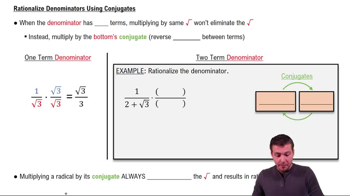
Conjugates of Binomials

The conjugate of a binomial expression like (√5 + √3) is (√5 - √3). Multiplying a binomial by its conjugate results in a difference of squares, which removes the square roots in the denominator, producing a rational number.
Recommended video:
3:42
Rationalizing Denominators Using Conjugates

Difference of Squares Formula

The difference of squares formula states that (a + b)(a - b) = a² - b². This property is used to simplify expressions involving conjugates, especially when rationalizing denominators containing sums or differences of square roots.
Recommended video:
2:25
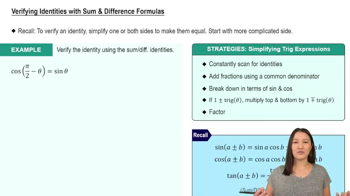
Verifying Identities with Sum and Difference Formulas